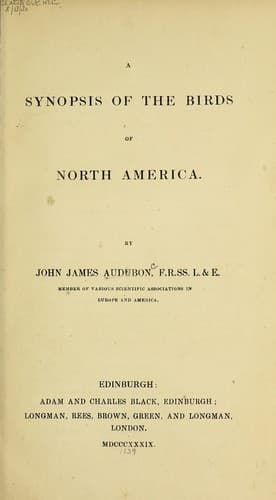
A Synopsis of the Birds of North AmericaAudubon, John James
Science
A Synopsis of the Birds of North America
Audubon, John James
Birds -- Classification; Birds -- North America
Bill as long as the head or somewhat longer, nearly straight, strong,
tapering, compressed from the base; upper mandible with its outline
slightly declinate, a little convex, the ridge narrow at the base and
encroaching a little on the forehead, afterwards broad, rounded, and
indistinct, the sides convex, the edges sharp and direct, or slightly
inflected, with a faint festoon anterior to the nostrils, the tip
deflected, acute; lower mandible with the angle short and rounded, the
dorsal line straight, slightly deflected at the end, the ridge convex,
the sides rounded, the edges inflected, the tip very acute. Nostrils
basal, oval, half-closed by a membrane. Head of moderate size, ovate,
flattened above; neck of moderate length; body rather slender. Feet of
moderate length; tarsus as long as the middle toe and claw,
compressed, with eight anterior scutella; toes rather long, with large
scutella, the hind toe stronger, the lateral toes nearly equal, the
middle toe much longer. Claws rather long, slightly arched,
compressed, not laterally grooved, acute. Plumage blended, highly
glossed. Wings of moderate length, the second and third quills
longest, the first and fourth little shorter. Tail long, graduated or
rounded, the feathers flat or slightly concave, slightly emarginate,
with the inner webs longer than the outer. Roof of the upper mandible
concave with three longitudinal ridges, of which the middle is
enlarged at the base and prominent; tongue slender, sagittate, concave
above, tapering to a thin lacerated point; œsophagus rather wide,
considerably dilated about the middle; stomach of moderate size,
elliptical or roundish, moderately muscular, the lateral muscles
distinct, the epithelium dense, horny, slightly rugous, with two
roundish grinding surfaces; intestine of moderate length, rather wide;
cœca very small; cloaca oblong.
220. 1. Quiscalus major, Vieill. Great Crow-Blackbird.--Boat-tailed
Grakle.
Plate CLXXXVII. Male and Female.
Tail very long, graduated, with the feathers slightly concave above.
Male with the plumage silky, splendent, the head and neck deep
purplish-blue, the back, breast, and sides deep blue, passing into
green behind, the rump bronzed black; the wings and tail black,
glossed with green, the abdomen, lower tail-coverts, and tibial
feathers, plain black. Female much smaller, with the tail shorter, the
plumage unglossed beneath, and but slightly glossy above, the upper
parts dusky, with slight tints of green and blue; the head and neck
dull brown; the lower parts light yellowish-brown, the tibial feathers
and lower tail-coverts dusky.
_Male_, 15-7/8, 23-3/4. _Female_, 12-5/8, 18.
Abundant from Texas to North Carolina along the coast. Up the
Mississippi about 200 miles. Constantly resident.
Quiscalus major, Bonap. Syn. p. 54.
Great Crow Blackbird, Quiscalus major, Bonap. Amer. Orn. v. i.
p. 35.
Great Crow Blackbird, Quiscalus major, Nutt. Man. v. i. p.
192.
Public-domain text, read in full here on John Shaqi.
Reviews
Reviews
No reviews yet
Be the first to share your thoughts on this work.
Elsewhere in the archive
Join the Discussion
Join the discussion
Sign in to leave a comment or review.
Sign InorCreate an account