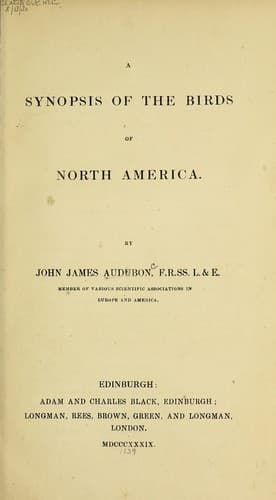
A Synopsis of the Birds of North AmericaAudubon, John James
Science
A Synopsis of the Birds of North America
Audubon, John James
Birds -- Classification; Birds -- North America
Upper parts variegated with dark brown, bay, and dull yellowish, the
latter bordering the feathers; those of the hind parts of the back
barred, as are the secondary quills and their coverts; primary quills
dark brown, margined, the outer with whitish, the rest with pale
yellowish; edge of the wing yellow; three outer tail-feathers white,
with a dash of black on the outer web near the end, the next feather
also more or less white, and barred on the outer web; on the upper
part of the head a central and two lateral bands of brownish-yellow,
the lateral hand sometimes white, anteriorly tinged with yellow;
sides of the head and neck greyish-white, flanks and lower
tail-coverts reddish-white, streaked with black; fore neck and breast
rich yellow, the former with a large crescent of black. Female
smaller, but otherwise similar.
_Male_, 11-2/12, 16-1/2.
Breeds from Texas to the Columbia River, and along the Atlantic coast
to Nova Scotia and the Fur Countries. Resident in the Southern and
Western States. Abundant.
Meadow Lark, Alauda magna, Wils. Amer. Orn. v. iii. p. 20.
Sturnus ludovicianus, Bonap. Syn.
Sturnus ludovicianus, Crescent Starlet, Swains. & Rich. F.
Bor. Amer. v. ii. p. 282.
American Starling or Meadow Lark, Nutt. Man. v. i. p. 147.
Meadow Lark or American Starling, Aud. Orn. Biog. v. ii. p.
216; v. v. p. 492.
FAMILY XVIII. CORVINÆ. CROWS.
Bill about the length of the head, robust, nearly straight,
compressed; upper mandible with the dorsal line more or less arched,
its tip slightly deflected, the edges sharp, with a slight notch or
sinus. Nostrils basal, roundish, concealed by reversed slender stiff
feathers. Head rather large, ovate; neck of moderate length, body
compact. Feet of ordinary length, rather stout; tarsus compressed,
with about eight large scutella; toes four, first stronger, but about
the same length as the second and fourth, which latter is adherent at
the base. Claws rather large, arched, compressed, acute. Plumage
various; wings long or of moderate length, much rounded, the first
quill about half the length of the fourth or fifth, which are longest;
tail of twelve broad feathers. Upper mandible concave, with several
longitudinal ridges; tongue oblong, flat above, horny, thin edged,
with the tip slit and lacerated; œsophagus of moderate width,
without dilatation; proventriculus bulbiform; stomach, a gizzard of
moderate power, with a rugous dense epithelium; intestine of moderate
length and width; cœca small, cylindrical, adnate. Trachea with
four pairs of inferior laryngeal muscles. Nest in high places, or in
cavities, rudely constructed; eggs from four to six, ovate or oblong.
GENUS I. CORVUS, Linn. CROW.
Public-domain text, read in full here on John Shaqi.
Reviews
Reviews
No reviews yet
Be the first to share your thoughts on this work.
Elsewhere in the archive
Join the Discussion
Join the discussion
Sign in to leave a comment or review.
Sign InorCreate an account