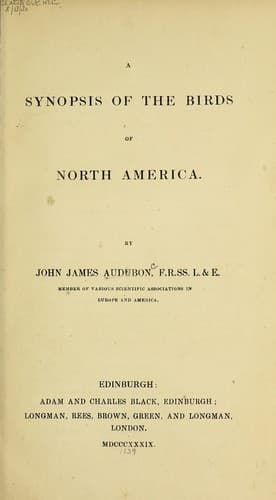
A Synopsis of the Birds of North AmericaAudubon, John James
Science
A Synopsis of the Birds of North America
Audubon, John James
Birds -- Classification; Birds -- North America
Bill long, being double the length of the head, rather slender, but
strong, much compressed, straight, its breadth less before the
nostrils, than towards the point; upper mandible with the dorsal line
straight until towards the end, then slightly arcuato-declinate, the
ridge convex in its whole length, the sides nearly erect, more convex
toward the extremity, the tip blunted, the edges broad and obtuse for
half their length, sharp but thick in the rest of their extent; lower
mandible slightly ascending at the base, then direct, much compressed
toward the tip, which is acute, the angle long and very narrow, the
dorsal line slightly convex, the edges obtuse, becoming sharp towards
the end; nasal groove nearly half the length of the bill. Nostrils
direct, linear, long. Head rather small, oblong, compressed; neck long
and slender; body ovato-oblong, much compressed. Feet very long,
rather stout; tibia bare in its lower half; tarsus long, compressed,
anteriorly broadly scutellate; toes long, rather slender; hind toe
small; fourth considerably longer than second; anterior toes divided
to the base, scutellate. Claws of moderate length, very slightly
arched, compressed, tapering to a point. Plumage rather compact above,
blended beneath. Wings of moderate length, very broad, concave,
rounded; first short, falciform, with the inner web broader toward the
end; fourth quill longest; inner secondaries much elongated. Tail
short, broad, convex, rounded, of twelve broad rounded feathers.
Digestive organs as in the Rails and Gallinules.
314. 1. Aramus scolopaceus, Vieill. Scolopaceous Courlan.
Plate CCCLXXVII. Male.
Bill greenish-yellow; feet leaden-grey; plumage chocolate-brown, the
upper parts glossed, with purple and brown reflections; fore part of
the head paler, inclining to grey, each feather with a greyish-white
central line; sides of the head and throat still lighter, and a small
portion of the throat whitish, these parts being streaked with
greyish-brown and greyish-white; lower eyelid white; hind part and
sides of neck marked with elliptical spots of white in regular series,
there being one on each feather, some of them extending forwards to
the posterior angle of the eye; some of the feathers on the middle of
the breast and the lower wing-coverts similarly marked with lanceolate
white spots; quills and tail glossy blackish-purple. Female somewhat
less, but similar. Young, when fledged, of a much lighter tint; head
and fore neck brownish-grey; excepting the quills, primary coverts,
tail-feathers, and rump, all the plumage marked with spots of white;
those on the neck elongated, on the back, wings, and breast
lanceolate.
_Male_, 25-3/4, 41. _Female_, 25, 42. _Young_, 23.
Confined to the Everglades and central parts of Florida, where it is
resident, but rather rare. Accidental on the Florida Keys.
Aramus scolopaceus, Bonap. Syn. p. 39.
Scolopaceous Courlan, Aramus scolopaceus, Bonap. Amer. Orn. v.
iv. p. 111.
Public-domain text, read in full here on John Shaqi.
Reviews
Reviews
No reviews yet
Be the first to share your thoughts on this work.
Elsewhere in the archive
Join the Discussion
Join the discussion
Sign in to leave a comment or review.
Sign InorCreate an account