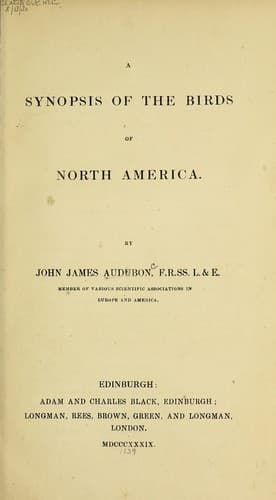
A Synopsis of the Birds of North AmericaAudubon, John James
Science
A Synopsis of the Birds of North America
Audubon, John James
Birds -- Classification; Birds -- North America
Scolopaceous Courlan, Aramus scolopaceus, Nutt. Man. v. ii. p.
68.
Scolopaceous Courlan, Aramus scolopaceus, Aud. Orn. Biog. v.
iv. p. 543.
FAMILY XXXIV. GRUINÆ. CRANES.
Bill about the length of the head, straight, depressed at the base,
compressed toward the end, rather obtuse. Nostrils subbasal, lateral
oblong. Head rather small, oblong; neck long; body large, compressed.
Legs long and slender; tibia bare at the lower part; tarsus somewhat
compressed, anteriorly scutellate; toes rather long, first short and
somewhat elevated; claws obtuse. Plumage full and rather compact.
Wings broad, convex, the inner secondaries elongated and decurved;
tail short, rounded.
GENUS I. GRUS, Briss. CRANE.
Bill longer than the head, straight, rather slender, but strong,
compressed, obtusely pointed; upper mandible with the dorsal line
nearly straight, a little concave at the middle, slightly declinate
toward the tip, the ridge flat and rather broad as far as the middle,
the sides sloping, towards the end convex; the nasal sinus narrow,
bare, and extending to nearly two-thirds, the edges direct, thick;
lower mandible with the angle narrow and very long, the sides
perpendicular at the base, the edges thick, the tip narrow and obtuse.
Nostrils subbasal, lateral, oblong, large, pervious. Head small,
compressed; neck very long and slender; body very large, but
compressed. Feet very long; tibia bare to a great extent; tarsus long,
stout, moderately compressed, anteriorly covered with broad decurved
scutella; toes stout, scutellate, of moderate length, marginate, the
first very small and elevated, the fourth webbed at the base. Claws of
moderate size, strong, considerably curved, rather compressed,
blunted. Plumage imbricated; upper part of head bare. Wings ample, the
second, third, and fourth longest, inner secondaries and their coverts
curved downwards. Tail short, rounded, of twelve broad, rounded
feathers.
315. 1. Grus Americana, Forster. Whooping Crane.--Sand-hill Crane.
White Crane. Blue Crane. Brown Crane.
Plate CCXXVI. Male. Plate CCLXI. Young.
Adult with the bill dusky green, the feet black, the bare part of the
head carmine, the plumage pure white, except the alula, primaries, and
primary coverts, which are brownish-black. Young with the bill and
feet brownish-black, the bare part of the head carmine, but less
extended, the plumage bluish-grey, the feathers margined with
yellowish-brown, chin and sides of head greyish-white, primary quills
and coverts dark brown towards the end, with brownish-white shafts.
_Male_, 54, 92.
From Texas to North Carolina during autumn and winter, and across to
the Rocky Mountains. Breeds from Upper California northward to the
Arctic Regions, from which it removes southward early in autumn.
Abundant in Georgia and Florida, and from thence to Texas.
Whooping Crane, Ardea Americana, Wils. Amer. Orn. v. vii. p.
20.
Grus Americana, Bonap. Syn. p. 302.
Public-domain text, read in full here on John Shaqi.
Reviews
Reviews
No reviews yet
Be the first to share your thoughts on this work.
Elsewhere in the archive
Join the Discussion
Join the discussion
Sign in to leave a comment or review.
Sign InorCreate an account