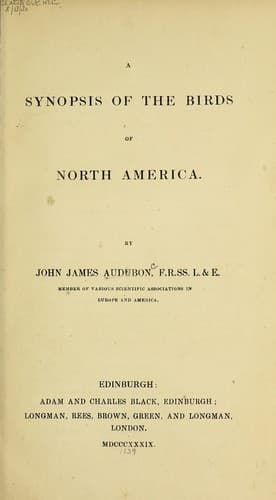
A Synopsis of the Birds of North AmericaAudubon, John James
Science
A Synopsis of the Birds of North America
Audubon, John James
Birds -- Classification; Birds -- North America
Bill long, slender, straight, or slightly recurvate, higher than broad
at the base, extremely compressed toward the end; upper mandible with
the dorsal line straight and slightly sloping at the base, somewhat
convex beyond the nostrils, then straight and sloping to the point,
the ridge broad and flattened as far as the prominence, afterwards
extremely narrow, the sides sloping at the base, perpendicular towards
the end, the edges rather sharp, the tip abrupt and wedge shaped;
nasal groove long, bare; lower mandible with the angle of moderate
length, the dorsal line ascending and slightly convex, the sides
erect, the edges thin, the tip abrupt and wedged. Nostrils subbasal,
linear, near the margin. Head of moderate size, ovate, the forehead
rounded; neck of moderate length; body compact. Feet of moderate
length, rather stout; tibia bare for about a fourth of its length;
tarsus slightly compressed, covered all round with hexagonal scales;
toes of moderate length, stout, marginate, flat beneath, webbed at the
base, the outer considerably longer than the inner, the first wanting.
Claws rather small, arched, moderately compressed, obtuse. Plumage
generally blended, on the back compact. Wings long, pointed, the first
quill longest. Tail short, nearly even, of twelve feathers. Tongue
short, triangular, fleshy; œsophagus dilated into a pretty large
crop; stomach oblong, muscular, with the epithelium dense and
longitudinally rugous; intestine long and rather slender; cœca long
and nearly cylindrical; cloaca globular.
325. 1. Hæmatopus palliatus, Temm. American Oyster-catcher.
Plate CCXXIII. Male.
Bill vermilion, feet very pale flesh-colour; head and neck dull black
tinged with bluish-grey; upper parts light greyish-brown, tinged with
olive, and faintly glossed with reddish-purple; lower eyelid, edge of
wing, tips of secondary coverts, secondary quills except the inner,
pure white; as are the lower parts generally, the rump, and basal half
of the tail; primaries and terminal part of tail brownish-black.
_Male_, 18-1/2, 32-1/2, bill 3-5/8. _Female_, 21, 36.
Breeds from Texas along the coast to New York, again from Maine to
Labrador. Returns south in autumn, spending the winter from Maryland
to West Florida. Rather common.
Hæmatopus palliatus, Temm. Man. d'Orn. v. ii. p. 532.
Mantled Oyster-catcher, Hæmatopus palliatus, Nutt. Man. v. ii.
p. 15.
American Oyster-catcher, Hæmatopus palliatus, Aud. Orn. Biog.
v. iii. p. 181; v. v. p. 580.
326. 2. Hæmatopus Bachmanii, Aud. Bachman's Oyster-catcher.
Plate CCCCXXVII. Fig. 1. Male.
Bill vermilion, fading to yellow on the worn parts towards the
end; feet white, slightly tinged with flesh-colour; plumage
chocolate-brown, darker and tinged with bluish-grey on the head and
neck; the under surface of the quills lighter.
_Male_, 17-1/2, wing 10; bill 2-3/4.
North-west coast, Regent's Sound, and about the mouth of the Columbia
River. Rather common. Migratory.
Public-domain text, read in full here on John Shaqi.
Reviews
Reviews
No reviews yet
Be the first to share your thoughts on this work.
Elsewhere in the archive
Join the Discussion
Join the discussion
Sign in to leave a comment or review.
Sign InorCreate an account