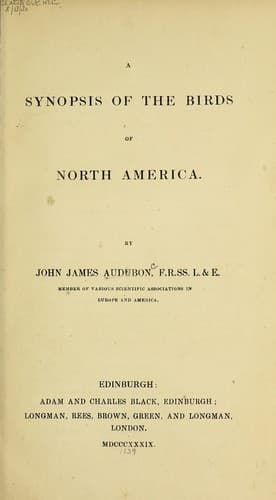
A Synopsis of the Birds of North AmericaAudubon, John James
Science
A Synopsis of the Birds of North America
Audubon, John James
Birds -- Classification; Birds -- North America
Bill little longer than the head, slender, straight, compressed,
tapering, with the tip a little enlarged and blunt; upper mandible
with the dorsal line straight and slightly declinate, the ridge narrow
and flattened until towards the end, when it becomes considerably
broader, the sides sloping, the tip convex above and ending in a blunt
point, the edges thick and flattened; nasal groove extending to near
the tip; lower mandible with the angle long and very narrow, the
dorsal line straight, the sides sloping outwards, with a long narrow
groove, the tip a little broader, but tapering. Head rather small,
oblong, compressed; neck of ordinary length; body rather full. Feet
rather long, slender; tibia bare a third part of its length; tarsus
anteriorly and posteriorly scutellate; hind toe very small, or
wanting, the rest of moderate length, slender, the fourth slightly
longer than the second, the third longest, all free, broadly
marginate, with numerous scutella. Claws small, slightly arched,
compressed, rather obtuse. Plumage soft, blended, on the back
distinct. Wings very long, pointed; primaries tapering, obtuse, the
first longest; one of the inner secondaries very long. Tail rather
short, nearly even, of twelve feathers.
328. 1. Tringa Bartramia, Wils. Bartramian Sandpiper.--Highland
Plover. Papabote.
Plate CCCIII. Male and Female.
Bill scarcely longer than the head, slender, slightly deflected at the
end, yellowish-green, with the tip dusky; legs rather long, light
greyish-yellow, toes greenish; upper part of head dark brown, with a
median pale yellowish-brown line, of which colour are the margins of
the feathers; hind part and sides of the neck light yellowish-brown,
streaked with dusky; fore part of neck and breast paler, with
longitudinal pointed dusky streaks, becoming transverse on the breast
and sides; throat and the rest of the lower parts yellowish-white,
except the axillars and lower wing-coverts which are white, banded
with brownish-black; on the upper parts the feathers dark brown
glossed with green, their margins with alternate yellowish-brown and
dusky spots; the hind part of the back darker, without spots; alula,
primary coverts, and primary quills, blackish-brown, the inner webs
crossed by white bands until about an inch from the end; the shaft of
first quill brownish-white, of the rest brown; secondaries
greyish-brown, the outer margins pale brown, with dusky spots, the
inner darker; two middle feathers of tail dark olive, tinged with
grey, transversely barred with black, the last bar arrow-shaped, the
margins cream-coloured; the next feather on each side lighter, and
tinged with yellowish-red, the rest gradually lighter, the outer
white, all barred with black.
_Male_, 12-1/2, 22. _Female_, 13, 22-3/4.
From Texas along the coast to Nova Scotia. Breeds from Maryland
northward to the Saskatchewan. In vast flocks in Louisiana,
Oppelousas, and the Western Prairies, in autumn and spring. Rare in
Kentucky.
Public-domain text, read in full here on John Shaqi.
Reviews
Reviews
No reviews yet
Be the first to share your thoughts on this work.
Elsewhere in the archive
Join the Discussion
Join the discussion
Sign in to leave a comment or review.
Sign InorCreate an account