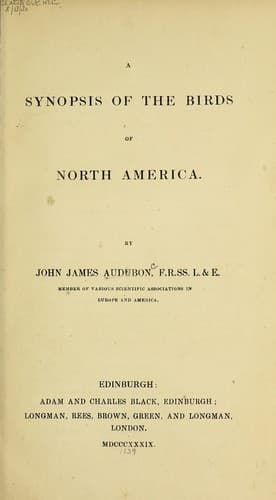
A Synopsis of the Birds of North AmericaAudubon, John James
Science
A Synopsis of the Birds of North America
Audubon, John James
Birds -- Classification; Birds -- North America
Bill not longer than the head, dull olive-green, dusky toward the
point; feet dull yellowish-green; upper parts greyish-yellow, each
feather blackish-brown in the centre; wing-coverts lighter; quills and
coverts light greyish-brown, greenish-black at the end, with the tip
whitish, the inner webs whitish in the greater part of their breadth,
and beautifully dotted with black, in undulating lines; the inner
secondaries like the back; the two middle tail-feathers greyish-brown,
at the end dark brown glossed with green, and slightly margined and
tipped with white, the rest gradually paler to the outer, margined and
tipped with white, within which are two lines of blackish-brown; sides
of the head, fore neck, and sides light yellowish-red, the throat
paler, the sides of the neck and body spotted with brownish-black, the
rest of the lower parts paler and unspotted; lower wing-coverts
white, those near the edge of the wing black in the centre, primary
coverts dotted with black, and having a spot of the same near the end.
_Male_, 8, 18.
Along the Atlantic shores from Maine to New York. Rare. Migratory.
Breeds in high northern latitudes.
Buff-breasted Sandpiper, Tringa rufescens, Nutt. Man. v. ii.
p. 113.
Buff-breasted Sandpiper, Tringa rufescens, Aud. Orn. Biog. v.
iii. p. 451.
333. 6. Tringa alpina, Linn. Red-backed Sandpiper.
Plate CCXC. Adult in summer and winter.
Bill one-third longer than the head, slender, slightly curved toward
the end, and with the feet black. Upper part of the head, back, and
scapulars, chestnut-red, each feather brownish-black in the centre,
and the scapulars barred with the same colour; wing-coverts
greyish-brown, as are the quills; the bases and tips of the
secondaries, and part of the outer webs of the middle primaries white;
tail light brownish-grey, the two middle feathers darker; forehead,
sides of head, and hind neck, pale reddish-grey, streaked with dusky;
fore neck and anterior part of breast greyish-white, streaked with
dusky; on the breast a large patch of brownish-black; abdomen and
lower tail-coverts white, the latter with dusky markings. In winter,
the general colour of the upper parts brownish-grey; the wings and
tail as in summer; throat greyish-white; sides of head and neck, and
fore part of the latter, pale brownish-grey, faintly streaked with
darker, as are the sides; the rest of the lower parts white, with a
few streaks on the breast.
_Male_, 8-1/2, 15.
From Nova Scotia to Texas, along all muddy or sandy shores, during
autumn and spring. Common. Breeds in great numbers on the Arctic
coasts.
Tringa Cinclus and alpina, Linn. Syst. Nat. v. i. p. 251, 429.
Red-backed Sandpiper, Tringa alpina, Wils. Amer. Orn. v. vii.
p. 5.
Tringa alpina, Bonap. Syn. p. 317.
Tringa alpina, American Dunlin, Swains. & Rich. F. Bor. Amer.
v. ii. p. 383.
Dunlin or Ox-bird, Nutt. Man. v. ii. p. 106.
Public-domain text, read in full here on John Shaqi.
Reviews
Reviews
No reviews yet
Be the first to share your thoughts on this work.
Elsewhere in the archive
Join the Discussion
Join the discussion
Sign in to leave a comment or review.
Sign InorCreate an account