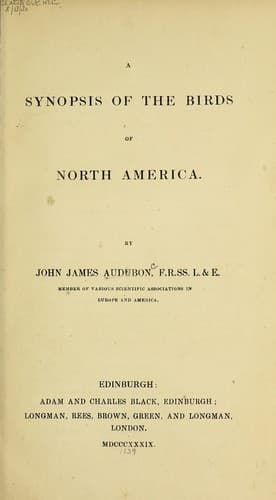
A Synopsis of the Birds of North AmericaAudubon, John James
Science
A Synopsis of the Birds of North America
Audubon, John James
Birds -- Classification; Birds -- North America
Red-backed Sandpiper, Tringa alpina, Aud. Orn. Biog. v. iii.
p. 580.
334. 7. Tringa subarquata, Temm. Curlew Sandpiper.
Plate CCLXIII. Adult and Young.
Bill one-third longer than the head, slightly decurved, dark olive;
feet light olive-green; head, neck, and breast, bright yellowish-red,
sides whitish, lower tail-coverts white, with a brownish-black spot
towards the end; on the upper part of the head the central parts of
the feathers dark brown, and the hind neck and sides of the breast
slightly streaked with the same; upper parts mottled with
brownish-black and light red, the rump pale brownish-grey, as are the
smaller wing-coverts; quills greyish-brown, primaries darker, outer
secondaries light and tipped with white, inner darker, and glossed
with green; upper tail-coverts white, spotted with brown and red; tail
pale brownish-grey, glossed with green. In winter, the feathers of the
upper parts dark brown, edged with darker, and margined with
greyish-yellow; lore, cheeks, and sides of the neck and body
greyish-yellow, with dusky lines; a broad band from mandible over the
eye, the fore part of the neck, and the rest of the lower parts white;
quills and tail as in winter, but lighter. Young in autumn like the
adult in winter.
Accidental on the Florida coast in winter, rare on those of the middle
districts. Breeds in high latitudes. Migratory.
Tringa subarquata, Bonap. Syn. p. 317.
Cape Curlew or Sandpiper, Nutt. Man. v. ii. p. 104.
Curlew Sandpiper, Tringa subarquata, Aud. Orn. Biog. v. iii.
p. 444.
335. 8. Tringa Himantopus, Bonap. Long-legged Sandpiper.
Plate CCCXLIV. Adult in spring and winter.
Bill a third longer than the head, slender, very slightly decurved;
greenish-black; legs long, slender, yellowish-green. In summer, their
upper parts brownish-black, the feathers margined with reddish-white,
the edges of the scapulars with semiform markings of the same; rump
and upper tail-coverts white, transversely barred with dusky; tail
light grey, the feathers white at the base and along the middle;
primary quills and coverts brownish-black, inner tinged with grey, the
shaft of the outer primary white; secondaries brownish-grey, margined
with reddish-white, the inner dusky; a broad whitish line over the
eye; loral space dusky; auriculars pale brownish-red; fore part and
sides of neck greyish-white tinged with red, and longitudinally
streaked with dusky, the rest of the lower parts pale reddish,
transversely barred with dusky, the middle of the breast and the
abdomen without markings. In winter, the upper parts brownish-grey,
the head narrowly streaked with dusky, the scapulars plainly margined
with whitish; the rump and wings as in summer; the band over the eye
lighter, the fore part and sides of neck greyish-white, longitudinally
streaked with grey, the sides similar, and with the lower coverts
barred with grey, the rest of the lower parts white.
Public-domain text, read in full here on John Shaqi.
Reviews
Reviews
No reviews yet
Be the first to share your thoughts on this work.
Elsewhere in the archive
Join the Discussion
Join the discussion
Sign in to leave a comment or review.
Sign InorCreate an account