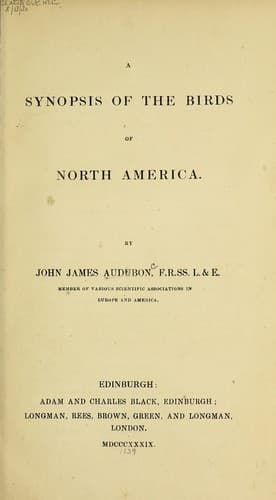
A Synopsis of the Birds of North AmericaAudubon, John James
Science
A Synopsis of the Birds of North America
Audubon, John James
Birds -- Classification; Birds -- North America
Esquimaux Curlew, Numenius borealis, Aud. Orn. Biog. v. iii.
p. 69; v. v. p. 590.
FAMILY XXXVII. TANTALINÆ. IBISES.
Bill very long, arcuate, rather stout at the base, obtuse. Nostrils
basal, linear or oblong. Head bare in front, rather large or of
moderate size; neck long and slender; body ovate. Legs long and rather
stout; tibia bare to a large extent; tarsus reticulate, sometimes
scaly in front; toes four, articulated on the same level, the anterior
webbed at the base, the first more slender. Claws arched, compressed,
rather obtuse. Wings long and very broad, with the second quill
longest. Tail short, of twelve feathers. Tongue triangular, extremely
short, flat, and thin. Œsophagus wide; stomach large, muscular,
broadly elliptical, with the epithelium dense, longitudinally rugous;
intestines generally of moderate length and width, cœca very small;
cloaca globular. Trachea without inferior laryngeal muscles.
GENUS I. IBIS, Cuv. IBIS.
Bill very long, slender, higher than broad, compressed, tapering,
arched, obtuse; upper mandible with the dorsal line arched in its
whole length, the ridge convex, broader towards the end, the sides at
the base erect, towards the end very convex and narrow, separated in
their whole length from the ridge by a deep narrow groove, the edges
inflected and sharp; lower mandible more slender, its angle very
narrow, and protracted in the form of a groove to the tip. Nostrils
basal, dorsal, linear. Head small, compressed, oblong, bare before the
eyes; neck long and slender; body rather slender. Feet very long,
slender; tarsi scutellate; anterior toes connected by membranes at the
base. Claws rather small, slightly arched, pointed. Wings long, ample,
with the second quill longest. Tail short, nearly even, of twelve
feathers. Œsophagus wide, like that of a heron; stomach muscular.
360. 1. Ibis Falcinellus, Linn. Glossy Ibis.
Plate CCCLXXXVII.
Bill black, bare part of head greyish-blue, feet greyish-black; upper
part and sides of head dark glossy green, with purplish reflections;
neck, part of the back anteriorly, breast, abdomen, and tibiæ, deep
rich brownish-red or dark chestnut; part of the breast shaded with
green, the sides dusky, tinged with green, as are the lower
wing-coverts and lower tail-coverts; except the anterior edge of the
wing, and the anterior scapulars, which are deep brownish-red, the
upper parts splendent dark green, glossed with purple; primaries
black, shaded with green; tail glossy, with purple reflection. Young,
in its second plumage, with the head, neck, and lower parts
greyish-brown, the head and greater part of the neck marked with small
longitudinal streaks of white, of which there are two on each feather;
all the upper parts blackish-green, glossy in a less degree than those
of the adult.
_Male_, 25, 42; wing, 11-1/4.
Public-domain text, read in full here on John Shaqi.
Reviews
Reviews
No reviews yet
Be the first to share your thoughts on this work.
Elsewhere in the archive
Join the Discussion
Join the discussion
Sign in to leave a comment or review.
Sign InorCreate an account