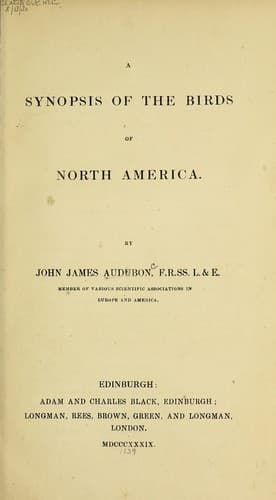
A Synopsis of the Birds of North AmericaAudubon, John James
Science
A Synopsis of the Birds of North America
Audubon, John James
Birds -- Classification; Birds -- North America
Resident in the Floridas and Texas, where it is abundant. Migrates
eastward to New Jersey, where it is rare; up the Mississippi to
Natchez. Never seen far inland.
Louisiana Heron, Ardea Ludoviciana, Wils. Amer. Orn. v. viii.
p. 13.
Ardea Ludoviciana, Bonap. Syn. p. 305.
Louisiana Heron, Nutt. Man. v. ii. p. 51.
Louisiana Heron, Ardea Ludoviciana, Aud. Orn. Biog. v. iii. p.
136; v. v. p. 605.
376. 12. Ardea candidissima, Gmel. Snowy Heron.
Plate CCXLII. Male.
Feathers of the upper and hind part of the head very long, loose,
decurved; of the middle of the back very long, loose, decurved, with
their extremities recurved; bill and legs black; toes yellow. Plumage
pure white. Young white, with the legs and toes dull green.
_Male_, 22-1/2, 38.
Resident from Texas to Florida. Migrates in spring as far as
Massachusetts. Breeds in all intermediate districts; up the
Mississippi to Memphis. Abundant.
Snowy Heron, Ardea candidissima. Wils. Amer. Orn. v. vii. p.
120.
Ardea candidissima, Bonap. Syn. p. 305.
Snowy Heron, Ardea candidissima, Nutt. Man. v. ii. p. 49.
Snowy Heron, Ardea candidissima, Aud. Orn. Biog. v. iii. p.
317; v. v. p. 606.
FAMILY XXXIX. ANATINÆ. DUCKS.
Bill of moderate length, stout, straight, depressed toward the end,
obtuse, covered with soft skin; upper mandible transversely convex,
with the margins internally lamellate, the tip furnished with a
decurved horny broad unguis; lower mandible with the angle long and
narrow, the crura slender, flattened, the edges internally lamellate,
the tip a flattened unguis. Nostrils elliptical, open, subbasal. Head
of moderate size; neck long or of moderate length, slender; body full;
legs generally short, stout, with little of the tibia bare; tarsus
scutellate; toes four, first small; anterior three palmate. Claws
moderate, arched, compressed, obtuse. Plumage very full, dense, soft.
Wings of moderate length, curved, acute, outer two quills longest.
Tail short, of twelve or more feathers. Tongue fleshy, with a median
groove, lateral reversed papillæ, laminæ, or bristles, and a
semicircular thin horny tip; œsophagus narrow, slightly enlarged at
the lower part of the neck; stomach a transversely elliptical gizzard,
of which the lateral muscles are excessively developed, the epithelium
dense, with two concave grinding surfaces; intestine long and wide;
cœca long, cylindrical, contracted at the base. Trachea various,
generally much enlarged at the bifurcation, without inferior laryngeal
muscles, or only with the slips of the lateral muscles prolonged. Nest
generally on the ground; eggs numerous. Young clothed with stiffish
down, and able to walk and swim from birth.
GENUS I. PHŒNICOPTERUS, Linn. FLAMINGO.
Public-domain text, read in full here on John Shaqi.
Reviews
Reviews
No reviews yet
Be the first to share your thoughts on this work.
Elsewhere in the archive
Join the Discussion
Join the discussion
Sign in to leave a comment or review.
Sign InorCreate an account