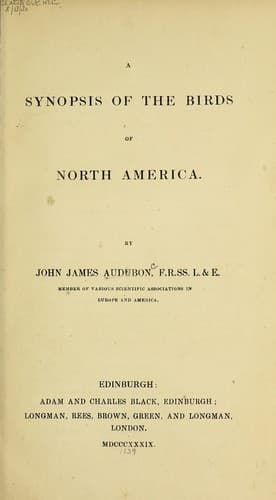
A Synopsis of the Birds of North AmericaAudubon, John James
Science
A Synopsis of the Birds of North America
Audubon, John James
Birds -- Classification; Birds -- North America
Bill more than double the length of the head, straight and higher than
broad for half its length, then deflected, and tapering to an obtuse
point; upper mandible with its dorsal line at first straight, then
convex, and again straight nearly to the end, when it becomes convex
at the tip, the ridge broad and concave, on the deflected part
expanded into a lanceolate plate, having a shallow groove in the
middle, and separated from the edges by a narrow groove, its extremity
narrow and thin edged, but obtuse, this part being analogous to the
unguis of ducks; lower mandible narrower than the upper at its base,
but much broader in the rest of its extent; its angle rather long,
wide, and filled with bare skin; its dorsal line concave, but at the
tip convex, the ridge deeply depressed, there being a wide channel in
its place, the sides nearly erect and a little convex, with six ridges
on each side toward the tip. Both mandibles internally lamellate, the
edge of the lower much incurved. Nostrils linear, direct, and
subbasal, operculate. Head small, ovate; neck extremely elongated, and
very slender; body slender; legs extremely long; tibia bare for more
than half its length, and with the long tarsus anteriorly scutellate;
hind toe very small and elevated; anterior toes connected by
emarginate webs, scutellate above, tesselate beneath. Claws oblong,
obtuse, depressed. Space between the bill and the eye bare; plumage
compact; wings long, very broad, pointed; second quill longest; some
of the secondaries extremely elongated, so as to extend far beyond the
primaries when the wing is closed. Tail very short. Tongue confined by
the lower mandible, fleshy, compressed, decurved, with recurved
conical papillæ; œsophagus extremely narrow, but at the lower part
of the neck enlarged into a crop; proventriculus elliptical; stomach a
very muscular, transversely elliptical gizzard, exactly resembling
that of a goose or duck, with the epithelium dense, and longitudinally
sulcate; intestine very long, and of considerable width; cœca
rather long; cloaca globular.
377. 1. Phœnicopterus ruber, Linn. American Flamingo.
Plate CCCCXXXI. Male.
Bill yellow tinged with bright orange, at the end black; feet lake;
plumage scarlet, excepting the ten primaries, and twenty of the
secondaries, which are black.
_Male_, 45-1/2, 66.
Rather rare, and only during summer in the Florida Keys, and the
western coast of Florida. Accidental as far as South Carolina.
Constantly resident in Cuba.
Red Flamingo, Phœnicopterus ruber, Wils. Amer. Orn, v.
viii. p. 145.
Phœnicopterus ruber, Bonap. Syn. p. 348.
American or Red Flamingo, Nutt. Man. v. ii. p. 71.
American Flamingo, Phœnicopterus ruber, Aud. Orn. Biog. v.
v. p. 255.
GENUS II. ANSER, Briss. GOOSE.
Public-domain text, read in full here on John Shaqi.
Reviews
Reviews
No reviews yet
Be the first to share your thoughts on this work.
Elsewhere in the archive
Join the Discussion
Join the discussion
Sign in to leave a comment or review.
Sign InorCreate an account