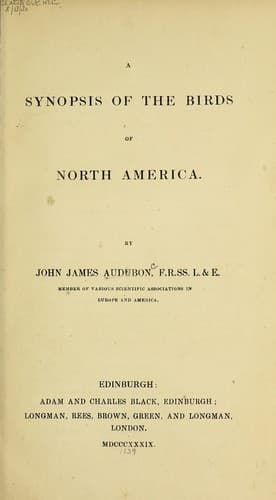
A Synopsis of the Birds of North AmericaAudubon, John James
Science
A Synopsis of the Birds of North America
Audubon, John James
Birds -- Classification; Birds -- North America
Bill longer than the head, rather slender, straight, upper mandible
with the ridge separated from the side by a groove, and terminated by
a narrow, generally decurved, pointed unguis; lower mandible with the
crura elastic and extensile, the angle very long and narrow. Nostrils
basal, lateral, linear, small, or obsolete. Space around and before
the eye generally bare, as is a portion of the gular sac. Head
generally of moderate size, but various; neck long; body elongated,
rather slender. Feet short and stout; tibia bare at its lower part;
tarsus short, very stout, compressed, scaly or scutellate in front;
toes four, all connected by webs, and scutellate; first small, fourth
longest. Claws short, strong, curved, rather blunt, that of the third
toe generally pectinate. Plumage soft, blended, on the back compact
and imbricated. Wings long; tail of moderate length, narrow, rounded
or tapering. Tongue extremely small, triangular, fleshy; œsophagus
excessively wide; a gular sac, sometimes of enormous capacity;
proventricular belt generally discontinuous; stomach very small,
slightly muscular, epithelium smooth; a globular pyloric lobe;
intestine very long and slender; cœca small, cylindrical; cloaca
globular. Trachea simple, flattened; no inferior laryngeal muscles.
GENUS I. PHALACROCORAX, Briss. CORMORANT.
Bill about the length of the head, rather slender, nearly straight,
compressed toward the end; upper mandible with the dorsal line
concave, until on the unguis, where it is decurved, the ridge convex,
flattened toward the end, separated from the sides by a narrow groove,
the sides convex, the edge sharp and nearly straight as far as the
unguis, which is decurved, convex above, acute, its tip ascending far
beyond that of the lower; lower mandible with the angle long and very
narrow towards the end, filled up by an extensile membrane, which
extends to the level of the angle of the mouth; the outline of the
crura very slightly convex, that of the terminal part descending and
very slightly convex, the sides convex, the edges sharp and inflected,
the tip compressed, with its marginal outline decurved. Nostrils
obliterated (in youth open). Head rather small, oblong; neck long and
rather thick; body full, elongated, depressed. Feet short, stout,
placed far behind; tibia feathered in its whole length; tarsus very
short, strong, much depressed, covered all round with angular scales;
a series on part of the inner side anteriorly, and another on the
lower part of the outer, scutelliform. Toes all placed in the same
plane, connected by webs, and covered above by very numerous oblique
scutella; first the smallest, fourth the longest. Claws rather small,
strong, compressed, acute, convex above, arched, that of the third toe
pectinated on its inner edge. Plumage soft, generally blended, compact
on the back and wings; the small gular sac, and the space before and
beneath the eye, with the eyelids, bare. Wings of moderate size,
Public-domain text, read in full here on John Shaqi.
Reviews
Reviews
No reviews yet
Be the first to share your thoughts on this work.
Elsewhere in the archive
Join the Discussion
Join the discussion
Sign in to leave a comment or review.
Sign InorCreate an account