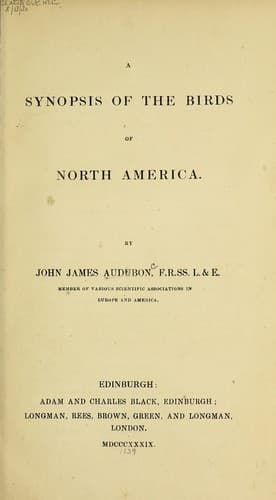
A Synopsis of the Birds of North AmericaAudubon, John James
Science
A Synopsis of the Birds of North America
Audubon, John James
Birds -- Classification; Birds -- North America
broad; primaries curved, pointed, the second longest. Tail of
moderate length, very narrow, much rounded, of twelve or more narrow
strong-shafted feathers. Gular sac small; tongue extremely small;
œsophagus very wide; proventricular glands disposed in two large
roundish masses; stomach small, slightly muscular, inner coat smooth
and soft; a globular or triangular pyloric lobe; duodenum at first
curving upwards; intestine very long, and of moderate width; cœca
small; rectum narrow; cloaca globular. Trachea considerably flattened;
bronchi of moderate width.
416. 1. Phalacrocorax Carbo, Linn. Great Cormorant.
Plate CCLXVI. Male, Female, and Young.
Tail of fourteen feathers. In summer, a small longitudinal occipital
black crest, and numerous linear elongated white feathers on the head
and upper part of neck; bill dusky, with the lower mandible whitish
toward the base; gular sac yellow; plumage black, glossed with deep
greenish-blue; at the base of the gular sac a broad gorgelet of white;
a patch of white on the side over the thigh; feathers of wings and
part of the back dull bluish-grey, glossed with bronze, their
fringe-like margins greenish-black; primary quills greyish-black,
secondary like the other wing-feathers; tail greyish-black; shafts of
all the feathers black at the end, leaden-grey towards the base.
Female similar. After the breeding season the white feathers on the
head and sides fall off. Young, before being fledged, with the skin
dull livid, the bill dusky, at the base flesh-coloured, the feet
purplish-dusky, the webs yellowish-brown.
_Male_, 37, 62.
Ranges during winter southward to New York. Abundant from
Massachusetts eastward. Breeds on high precipitous rocks, in
Newfoundland, Labrador, and Baffin's Bay. Migratory.
Phalacrocorax Carbo, Bonap. Syn. p. 402.
Cormorant, Nutt. Man. v. ii. p. 479.
Common Cormorant. Phalacrocorax Carbo, Aud. Orn. Biog. v. iii.
p. 458.
417. 2. Phalacrocorax dilophus, Swains. Double-crested Cormorant.
Plate CCLVII. Male.
Tail of twelve feathers. In summer an elongated tuft of about forty
long, slender, loose, recurved feathers, from behind the eye to the
length of an inch and a half on each side; upper mandible dusky, along
the edges greenish-yellow, lower yellow, irregularly marked with
dusky toward the edges; bare space on the head, and gular sac rich
orange; plumage greenish-black, strongly glossed with green;
imbricated feathers on the back and wings greyish-brown, their
fringe-like margins greenish-black; primary quills brownish-black,
secondary like the other wing-feathers; tail black; the shafts of all
the feathers black. Female similar to the male. After the breeding
season the tufts disappear. Young after the first moult have the head
and neck mottled with greenish-black and greyish-brown, the other
parts as in the adult, but the tufts on the head wanting.
_Male_, 33, 51.
Public-domain text, read in full here on John Shaqi.
Reviews
Reviews
No reviews yet
Be the first to share your thoughts on this work.
Elsewhere in the archive
Join the Discussion
Join the discussion
Sign in to leave a comment or review.
Sign InorCreate an account