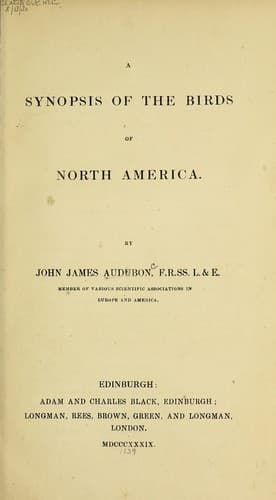
A Synopsis of the Birds of North AmericaAudubon, John James
Science
A Synopsis of the Birds of North America
Audubon, John James
Birds -- Classification; Birds -- North America
Bill about the length of the head, stout; wings longer than the tail,
which is moderately forked; bill and feet black; upper part of the
head and occiput greenish-black; sides of the head, fore neck, and all
the lower parts, white; upper parts pale greyish-blue, edges of the
wings whitish; primaries hoary on the outer web, deep grey on the
inner, their shafts and those of the tail-feathers white; the tail of
a paler tint than the back, and the outer feather nearly white.
_Male_, 14, 34.
Cosmopolite. In America, breeds from the mouth of the Mississippi to
Connecticut. Not abundant. Migratory.
Marsh Tern, Sterna aranea, Wils. Amer. Orn. v. viii. p. 143.
Sterna aranea, Bonap. Syn. p. 354.
Marsh Tern, Sterna anglica, Nutt. Man. v. ii. p. 269.
Marsh or Gull-billed Tern, Sterna anglica, Aud. Orn. Biog. v.
v. p. 127.
431. 3. Sterna Cantiaca, Gmel. Sandwich Tern.
Plate CCLXXIX. Adult.
Bill considerably longer than the head, rather slender, black, with
the tips yellow; inside of mouth deep blue; feet black; wings longer
than the tail, which is deeply forked; upper part of head and hind
neck bluish-black; sides of head, neck all round, and the rest of the
lower parts white, the sides and breast tinged with pink; fore part of
back, scapulars, and upper surface of wings pale greyish-blue; the
tips and greater part of the inner webs of the scapulars and quills
white, as are the rump and tail; the four outer quills blackish, but
covered with light grey down on the outer webs, and over a
considerable extent of the inner, their shafts white. Young, after the
first moult, of a light greyish-blue on the upper parts, the feathers
tipped and banded in an undulating manner with brownish-black; the
upper part of the head and hind neck brownish-black mottled with
white; quills as in the adult; tail grey, with irregular blackish
markings towards the tips of the feathers; lower parts of a much
lighter pale grey; bill and feet black.
_Adult_, 15-3/4, 33-3/4.
From Texas, during spring and summer, to the Floridas, where it breeds
in great numbers. Never observed in any other part of the coast of
America. Migratory.
Sandwich Tern. Nutt. Man. v. ii. p. 276.
Sandwich Tern, Sterna cantiaca, Aud. Orn. Biog. v. iii. p.
531.
432. 4. Sterna fuliginosa, Lath. Sooty Tern.
Plate CCXXXV.
Bill slightly longer than the head, rather slender, and with the feet
black; tail very deeply forked, much longer than the wings; forehead
white; lores, upper part of head, hind neck, and all the upper parts
deep black, tinged with brown, on the head glossed with blue; edges of
wings and lateral tail-feathers white, the latter with the inner web
toward the end dusky; lower parts and sides of head and neck pure
white. Young with the lower parts and forehead white, the upper parts
greyish-brown, the feathers edged with brownish-white, the primary
quills greyish-black.
_Male_, 16-1/4, 34-3/4.
Public-domain text, read in full here on John Shaqi.
Reviews
Reviews
No reviews yet
Be the first to share your thoughts on this work.
Elsewhere in the archive
Join the Discussion
Join the discussion
Sign in to leave a comment or review.
Sign InorCreate an account