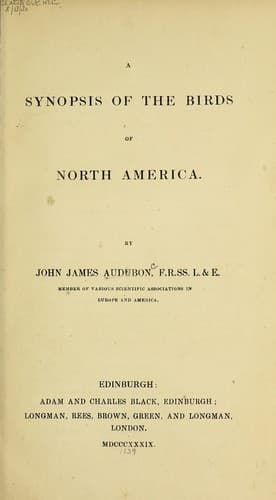
A Synopsis of the Birds of North AmericaAudubon, John James
Science
A Synopsis of the Birds of North America
Audubon, John James
Birds -- Classification; Birds -- North America
During winter, in vast multitudes on the coast of Florida. In summer
dispersed in large flocks from Texas to New Jersey, breeding on sand
beaches or islands. In the evenings and at night ascends streams
sometimes to the distance of one hundred miles.
Black Skimmer or Shear-water, Rhynchops nigra, Wils. Amer.
Orn. v. vii. p. 85.
Rhincops nigra, Bonap. Syn. p. 352.
Black Skimmer, Nutt. Man. v. ii. p. 264.
Black Skimmer or Razor-billed Shear-water, Rhynchops nigra,
Aud. Orn. Biog. v. iv. p. 203.
GENUS II. STERNA, Linn. TERN.
Bill longer than the head, rather stout or slender, nearly straight,
compressed, very acute; upper mandible with the dorsal line slightly
arched, the ridge rather broad and convex at the base, gradually
narrowed toward the end, sides convex, edges sharp and direct, tip
acute; nasal groove short; lower mandible with the angle very narrow,
acute, extending to the middle, the dorsal line straight, the sides
slightly convex, nearly erect, the sharp edges inflected, the tips
very acute. Nostrils basal, lateral, linear, direct. Head rather
large, oblong; neck of moderate length and thick; body slender. Feet
short, moderately stout; tibia bare for a considerable space; tarsus
short, roundish, covered all round with small scales; first toe very
small, third longest, fourth a little shorter; anterior toes connected
by emarginate webs. Claws slightly curved, compressed, acute. Plumage
soft, close, blended, rather compact on the back and wings. Wings
extremely long, narrow, and pointed, the first quill longest, the rest
rapidly graduated. Tail long, generally forked, of twelve feathers.
Tongue very slender, tapering, with the point slit; œsophagus
extremely wide; proventricular belt complete; stomach rather small,
moderately muscular, with the epithelium dense and longitudinally
rugous; intestine of moderate length, rather narrow; cœca small.
429. 1. Sterna Cayana, Lath. Cayenne Tern.
Plate CCLXXIII. Male.
Bill longer than the head, stout; wings longer than the tail, which is
moderately forked; bill carmine; feet black; upper part of the head
and occiput greenish-black; back and wings light greyish-blue; primary
quills bluish-grey on their outer webs, darker on the outer part of
the inner, their inner part white, as are the ends and inner webs of
the secondaries; upper tail-coverts and tail greyish-white; all the
other parts pure white.
_Male_, 19, 44.
From Texas, in spring, to the Floridas, where it breeds on the
Tortugas. Labrador, but not observed in the intermediate parts of the
Atlantic coast. Abundant. Migratory.
Sterna cayana, Bonap. Syn. v. ii. p. 353.
Cayenne Tern, Nutt. Man. v. ii. p. 208.
Cayenne Tern, Sterna cayana, Aud. Orn. Biog. v. iii. p. 505;
v. v. p. 639.
430. 2. Sterna Anglica, Montagu. Gull-billed Tern.--Marsh Tern.
Plate CCCCX. Male.
Public-domain text, read in full here on John Shaqi.
Reviews
Reviews
No reviews yet
Be the first to share your thoughts on this work.
Elsewhere in the archive
Join the Discussion
Join the discussion
Sign in to leave a comment or review.
Sign InorCreate an account