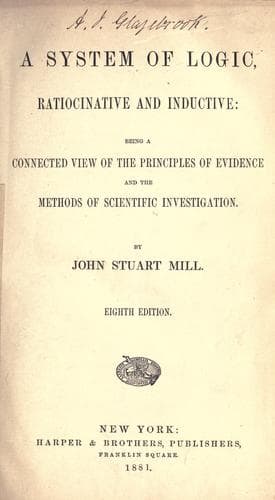
A System of Logic, Ratiocinative and InductiveMill, John Stuart
PhilosophyPhilosophy
A System of Logic, Ratiocinative and Inductive
Mill, John Stuart
Knowledge, Theory of; Logic; Science -- Methodology
respecting an attribute, may be transformed into an assertion exactly
equivalent respecting the fact or phenomenon which is the ground of the
attribute. And no case can be assigned, where that which is predicated of
the fact or phenomenon, does not belong to one or other of the five
species formerly enumerated: it is either simple Existence, or it is some
Sequence, Co-existence, Causation, or Resemblance.
And as these five are the only things which can be affirmed, so are they
the only things which can be denied. “No horses are web-footed” denies
that the attributes of a horse ever co-exist with web-feet. It is scarcely
necessary to apply the same analysis to Particular affirmations and
negations. “Some birds are web-footed,” affirms that, with the attributes
connoted by _bird_, the phenomenon web-feet is sometimes co-existent:
“Some birds are not web-footed,” asserts that there are other instances in
which this co-existence does not have place. Any further explanation of a
thing which, if the previous exposition has been assented to, is so
obvious, may here be spared.
Chapter VI.
Of Propositions Merely Verbal.
§ 1. As a preparation for the inquiry which is the proper object of Logic,
namely, in what manner propositions are to be proved, we have found it
necessary to inquire what they contain which requires, or is susceptible
of, proof; or (which is the same thing) what they assert. In the course of
this preliminary investigation into the import of Propositions, we
examined the opinion of the Conceptualists, that a proposition is the
expression of a relation between two ideas; and the doctrine of the
extreme Nominalists, that it is the expression of an agreement or
disagreement between the meanings of two names. We decided that, as
general theories, both of these are erroneous; and that, though
propositions may be made both respecting names and respecting ideas,
neither the one nor the other are the subject-matter of Propositions
considered generally. We then examined the different kinds of
Propositions, and found that, with the exception of those which are merely
verbal, they assert five different kinds of matters of fact, namely,
Existence, Order in Place, Order in Time, Causation, and Resemblance; that
in every proposition one of these five is either affirmed, or denied, of
some fact or phenomenon, or of some object the unknown source of a fact or
phenomenon.
Public-domain text, read in full here on John Shaqi.
Reviews
Reviews
No reviews yet
Be the first to share your thoughts on this work.
Elsewhere in the archive
Join the Discussion
Join the discussion
Sign in to leave a comment or review.
Sign InorCreate an account