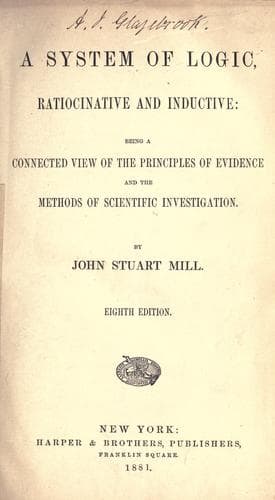
A System of Logic, Ratiocinative and InductiveMill, John Stuart
PhilosophyPhilosophy
A System of Logic, Ratiocinative and Inductive
Mill, John Stuart
Knowledge, Theory of; Logic; Science -- Methodology
In order to throw still further light upon the import of propositions of
which the terms are abstract, we will subject one of the examples given
above to a minuter analysis. The proposition we shall select is the
following: “Prudence is a virtue.” Let us substitute for the word virtue
an equivalent but more definite expression, such as “a mental quality
beneficial to society,” or “a mental quality pleasing to God,” or whatever
else we adopt as the definition of virtue. What the proposition asserts is
a sequence, accompanied with causation; namely, that benefit to society,
or that the approval of God, is consequent on, and caused by, prudence.
Here is a sequence; but between what? We understand the consequent of the
sequence, but we have yet to analyze the antecedent. Prudence is an
attribute; and, in connection with it, two things besides itself are to be
considered; prudent persons, who are the _subjects_ of the attribute, and
prudential conduct, which may be called the _foundation_ of it. Now is
either of these the antecedent? and, first, is it meant, that the approval
of God, or benefit to society, is attendant upon all prudent _persons_?
No; except _in so far_ as they are prudent; for prudent persons who are
scoundrels can seldom, on the whole, be beneficial to society, nor can
they be acceptable to a good being. Is it upon prudential _conduct_, then,
that divine approbation and benefit to mankind are supposed to be
invariably consequent? Neither is this the assertion meant, when it is
said that prudence is a virtue; except with the same reservation as
before, and for the same reason, namely, that prudential conduct, although
in _so far as_ it is prudential it is beneficial to society, may yet, by
reason of some other of its qualities, be productive of an injury
outweighing the benefit, and deserve a displeasure exceeding the
approbation which would be due to the prudence. Neither the substance,
therefore (viz., the person), nor the phenomenon (the conduct), is an
antecedent on which the other term of the sequence is universally
consequent. But the proposition, “Prudence is a virtue,” is a universal
proposition. What is it, then, upon which the proposition affirms the
effects in question to be universally consequent? Upon that in the person,
and in the conduct, which causes them to be called prudent, and which is
equally in them when the action, though prudent, is wicked; namely, a
correct foresight of consequences, a just estimation of their importance
to the object in view, and repression of any unreflecting impulse at
variance with the deliberate purpose. These, which are states of the
person’s mind, are the real antecedent in the sequence, the real cause in
the causation, asserted by the proposition. But these are also the real
ground, or foundation, of the attribute Prudence; since wherever these
states of mind exist we may predicate prudence, even before we know
whether any conduct has followed. And in this manner every assertion
Public-domain text, read in full here on John Shaqi.
Reviews
Reviews
No reviews yet
Be the first to share your thoughts on this work.
Elsewhere in the archive
Join the Discussion
Join the discussion
Sign in to leave a comment or review.
Sign InorCreate an account