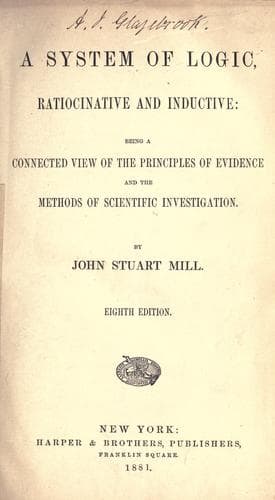
A System of Logic, Ratiocinative and InductiveMill, John Stuart
PhilosophyPhilosophy
A System of Logic, Ratiocinative and Inductive
Mill, John Stuart
Knowledge, Theory of; Logic; Science -- Methodology
But these reflections, so easy to us, would have been difficult to persons
who thought, as most of the later Aristotelians did, that objects were
made what they were called, that gold (for instance) was made gold, not by
the possession of certain properties to which mankind have chosen to
attach that name, but by participation in the nature of a general
substance, called gold in general, which substance, together with all the
properties that belonged to it, _inhered_ in every individual piece of
gold.(39) As they did not consider these universal substances to be
attached to all general names, but only to some, they thought that an
object borrowed only a part of its properties from a universal substance,
and that the rest belonged to it individually: the former they called its
essence, and the latter its accidents. The scholastic doctrine of essences
long survived the theory on which it rested, that of the existence of real
entities corresponding to general terms; and it was reserved for Locke, at
the end of the seventeenth century, to convince philosophers that the
supposed essences of classes were merely the signification of their names;
nor, among the signal services which his writings rendered to philosophy,
was there one more needful or more valuable.
Now, as the most familiar of the general names by which an object is
designated usually connotes not one only, but several attributes of the
object, each of which attributes separately forms also the bond of union
of some class, and the meaning of some general name; we may predicate of a
name which connotes a variety of attributes, another name which connotes
only one of these attributes, or some smaller number of them than all. In
such cases, the universal affirmative proposition will be true; since
whatever possesses the whole of any set of attributes, must possess any
part of that same set. A proposition of this sort, however, conveys no
information to any one who previously understood the whole meaning of the
terms. The propositions, Every man is a corporeal being, Every man is a
living creature, Every man is rational, convey no knowledge to any one who
was already aware of the entire meaning of the word _man_, for the meaning
of the word includes all this: and that every _man_ has the attributes
connoted by all these predicates, is already asserted when he is called a
man. Now, of this nature are all the propositions which have been called
essential. They are, in fact, identical propositions.
Public-domain text, read in full here on John Shaqi.
Reviews
Reviews
No reviews yet
Be the first to share your thoughts on this work.
Elsewhere in the archive
Join the Discussion
Join the discussion
Sign in to leave a comment or review.
Sign InorCreate an account