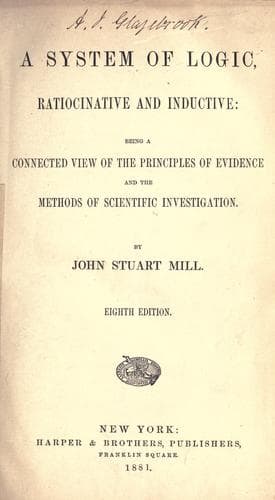
A System of Logic, Ratiocinative and InductiveMill, John Stuart
PhilosophyPhilosophy
A System of Logic, Ratiocinative and Inductive
Mill, John Stuart
Knowledge, Theory of; Logic; Science -- Methodology
It is true that a proposition which predicates any attribute, even though
it be one implied in the name, is in most cases understood to involve a
tacit assertion that there _exists_ a thing corresponding to the name, and
possessing the attributes connoted by it; and this implied assertion may
convey information, even to those who understood the meaning of the name.
But all information of this sort, conveyed by all the essential
propositions of which man can be made the subject, is included in the
assertion, Men exist. And this assumption of real existence is, after all,
the result of an imperfection of language. It arises from the ambiguity of
the copula, which, in addition to its proper office of a mark to show that
an assertion is made, is also, as formerly remarked, a concrete word
connoting existence. The actual existence of the subject of the
proposition is therefore only apparently, not really, implied in the
predication, if an essential one: we may say, A ghost is a disembodied
spirit, without believing in ghosts. But an accidental, or non-essential,
affirmation, does imply the real existence of the subject, because in the
case of a non-existent subject there is nothing for the proposition to
assert. Such a proposition as, The ghost of a murdered person haunts the
couch of the murderer, can only have a meaning if understood as implying a
belief in ghosts; for since the signification of the word ghost implies
nothing of the kind, the speaker either means nothing, or means to assert
a thing which he wishes to be believed to have really taken place.
Public-domain text, read in full here on John Shaqi.
Reviews
Reviews
No reviews yet
Be the first to share your thoughts on this work.
Elsewhere in the archive
Join the Discussion
Join the discussion
Sign in to leave a comment or review.
Sign InorCreate an account