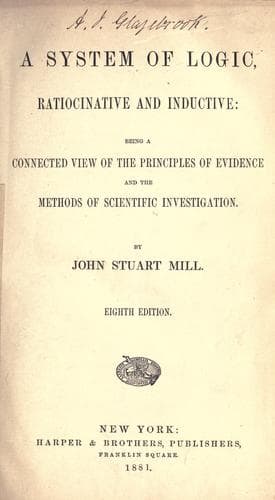
A System of Logic, Ratiocinative and InductiveMill, John Stuart
PhilosophyPhilosophy
A System of Logic, Ratiocinative and Inductive
Mill, John Stuart
Knowledge, Theory of; Logic; Science -- Methodology
It will be hereafter seen that when any important consequences seem to
follow, as in mathematics, from an essential proposition, or, in other
words, from a proposition involved in the meaning of a name, what they
really flow from is the tacit assumption of the real existence of the
objects so named. Apart from this assumption of real existence, the class
of propositions in which the predicate is of the essence of the subject
(that is, in which the predicate connotes the whole or part of what the
subject connotes, but nothing besides) answer no purpose but that of
unfolding the whole or some part of the meaning of the name, to those who
did not previously know it. Accordingly, the most useful, and in
strictness the only useful kind of essential propositions, are
Definitions: which, to be complete, should unfold the whole of what is
involved in the meaning of the word defined; that is (when it is a
connotative word), the whole of what it connotes. In defining a name,
however, it is not usual to specify its entire connotation, but so much
only as is sufficient to mark out the objects usually denoted by it from
all other known objects. And sometimes a merely accidental property, not
involved in the meaning of the name, answers this purpose equally well.
The various kinds of definition which these distinctions give rise to, and
the purposes to which they are respectively subservient, will be minutely
considered in the proper place.
§ 3. According to the above view of essential propositions, no proposition
can be reckoned such which relates to an individual by name, that is, in
which the subject is a proper name. Individuals have no essences. When the
schoolmen talked of the essence of an individual, they did not mean the
properties implied in its name, for the names of individuals imply no
properties. They regarded as of the essence of an individual, whatever was
of the essence of the species in which they were accustomed to place that
individual; _i.e._, of the class to which it was most familiarly referred,
and to which, therefore, they conceived that it by nature belonged. Thus,
because the proposition Man is a rational being, was an essential
proposition, they affirmed the same thing of the proposition, Julius Cæsar
is a rational being. This followed very naturally if genera and species
were to be considered as entities, distinct from, but _inhering_ in, the
individuals composing them. If _man_ was a substance inhering in each
individual man, the _essence_ of man (whatever that might mean) was
naturally supposed to accompany it; to inhere in John Thompson, and to
form the _common essence_ of Thompson and Julius Cæsar. It might then be
fairly said, that rationality, being of the essence of Man, was of the
essence also of Thompson. But if Man altogether be only the individual men
and a name bestowed upon them in consequence of certain common properties,
what becomes of John Thompson’s essence?
Public-domain text, read in full here on John Shaqi.
Reviews
Reviews
No reviews yet
Be the first to share your thoughts on this work.
Elsewhere in the archive
Join the Discussion
Join the discussion
Sign in to leave a comment or review.
Sign InorCreate an account