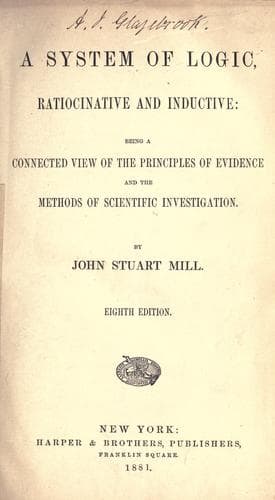
A System of Logic, Ratiocinative and InductiveMill, John Stuart
PhilosophyPhilosophy
A System of Logic, Ratiocinative and Inductive
Mill, John Stuart
Knowledge, Theory of; Logic; Science -- Methodology
§ 4. An essential proposition, then, is one which is purely verbal; which
asserts of a thing under a particular name, only what is asserted of it in
the fact of calling it by that name; and which, therefore, either gives no
information, or gives it respecting the name, not the thing.
Non-essential, or accidental propositions, on the contrary, may be called
Real Propositions, in opposition to Verbal. They predicate of a thing some
fact not involved in the signification of the name by which the
proposition speaks of it; some attribute not connoted by that name. Such
are all propositions concerning things individually designated, and all
general or particular propositions in which the predicate connotes any
attribute not connoted by the subject. All these, if true, add to our
knowledge: they convey information, not already involved in the names
employed. When I am told that all, or even that some objects, which have
certain qualities, or which stand in certain relations, have also certain
other qualities, or stand in certain other relations, I learn from this
proposition a new fact; a fact not included in my knowledge of the meaning
of the words, nor even of the existence of Things answering to the
signification of those words. It is this class of propositions only which
are in themselves instructive, or from which any instructive propositions
can be inferred.(41)
Nothing has probably contributed more to the opinion so long prevalent of
the futility of the school logic, than the circumstance that almost all
the examples used in the common school books to illustrate the doctrine of
predication and that of the syllogism, consist of essential propositions.
They were usually taken either from the branches or from the main trunk of
the Predicamental Tree, which included nothing but what was of the
_essence_ of the species: _Omne corpus est substantia_, _Omne animal est
corpus_, _Omnis homo est corpus_, _Omnis homo est animal_, _Omnis homo est
rationalis_, and so forth. It is far from wonderful that the syllogistic
art should have been thought to be of no use in assisting correct
reasoning, when almost the only propositions which, in the hands of its
professed teachers, it was employed to prove, were such as every one
assented to without proof the moment he comprehended the meaning of the
words; and stood exactly on a level, in point of evidence, with the
premises from which they were drawn. I have, therefore, throughout this
work, avoided the employment of essential propositions as examples, except
where the nature of the principle to be illustrated specifically required
them.
Public-domain text, read in full here on John Shaqi.
Reviews
Reviews
No reviews yet
Be the first to share your thoughts on this work.
Elsewhere in the archive
Join the Discussion
Join the discussion
Sign in to leave a comment or review.
Sign InorCreate an account