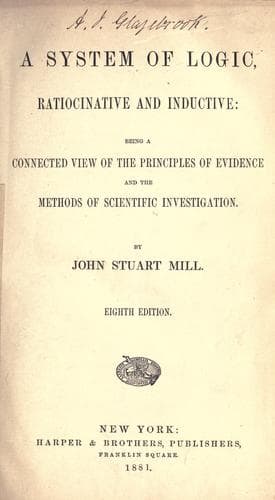
A System of Logic, Ratiocinative and InductiveMill, John Stuart
PhilosophyPhilosophy
A System of Logic, Ratiocinative and Inductive
Mill, John Stuart
Knowledge, Theory of; Logic; Science -- Methodology
§ 5. With respect to propositions which do convey information—which assert
something of a Thing, under a name that does not already presuppose what
is about to be asserted; there are two different aspects in which these,
or rather such of them as are general propositions, may be considered: we
may either look at them as portions of speculative truth, or as memoranda
for practical use. According as we consider propositions in one or the
other of these lights, their import may be conveniently expressed in one
or in the other of two formulas.
According to the formula which we have hitherto employed, and which is
best adapted to express the import of the proposition as a portion of our
theoretical knowledge, All men are mortal, means that the attributes of
man are always accompanied by the attribute mortality: No men are gods,
means that the attributes of man are never accompanied by the attributes,
or at least never by all the attributes, signified by the word god. But
when the proposition is considered as a memorandum for practical use, we
shall find a different mode of expressing the same meaning better adapted
to indicate the office which the proposition performs. The practical use
of a proposition is, to apprise or remind us what we have to expect, in
any individual case which comes within the assertion contained in the
proposition. In reference to this purpose, the proposition, All men are
mortal, means that the attributes of man are _evidence of_, are a _mark_
of, mortality; an indication by which the presence of that attribute is
made manifest. No men are gods, means that the attributes of man are a
mark or evidence that some or all of the attributes understood to belong
to a god are not there; that where the former are, we need not expect to
find the latter.
These two forms of expression are at bottom equivalent; but the one points
the attention more directly to what a proposition means, the latter to the
manner in which it is to be used.
Now it is to be observed that Reasoning (the subject to which we are next
to proceed) is a process into which propositions enter not as ultimate
results, but as means to the establishment of other propositions. We may
expect, therefore, that the mode of exhibiting the import of a general
proposition which shows it in its application to practical use, will best
express the function which propositions perform in Reasoning. And
accordingly, in the theory of Reasoning, the mode of viewing the subject
which considers a Proposition as asserting that one fact or phenomenon is
a _mark_ or _evidence_ of another fact or phenomenon, will be found almost
indispensable. For the purposes of that Theory, the best mode of defining
the import of a proposition is not the mode which shows most clearly what
it is in itself, but that which most distinctly suggests the manner in
which it may be made available for advancing from it to other
propositions.
Chapter VII.
Public-domain text, read in full here on John Shaqi.
Reviews
Reviews
No reviews yet
Be the first to share your thoughts on this work.
Elsewhere in the archive
Join the Discussion
Join the discussion
Sign in to leave a comment or review.
Sign InorCreate an account