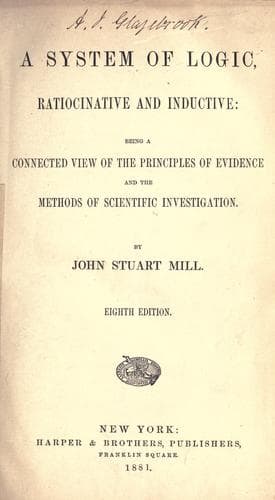
A System of Logic, Ratiocinative and InductiveMill, John Stuart
PhilosophyPhilosophy
A System of Logic, Ratiocinative and Inductive
Mill, John Stuart
Knowledge, Theory of; Logic; Science -- Methodology
§ 3. Of these five names, two, Genus and Species, are not only used by
naturalists in a technical acceptation not precisely agreeing with their
philosophical meaning, but have also acquired a popular acceptation, much
more general than either. In this popular sense any two classes, one of
which includes the whole of the other and more, may be called a Genus and
a Species. Such, for instance, are Animal and Man; Man and Mathematician.
Animal is a Genus; Man and Brute are its two species; or we may divide it
into a greater number of species, as man, horse, dog, etc. _Biped_, or
_two-footed animal_, may also be considered a genus, of which man and bird
are two species. _Taste_ is a genus, of which sweet taste, sour taste,
salt taste, etc., are species. _Virtue_ is a genus; justice, prudence,
courage, fortitude, generosity, etc., are its species.
The same class which is a genus with reference to the sub-classes or
species included in it, may be itself a species with reference to a more
comprehensive, or, as it is often called, a superior genus. Man is a
species with reference to animal, but a genus with reference to the
species Mathematician. Animal is a genus, divided into two species, man
and brute; but animal is also a species, which, with another species,
vegetable, makes up the genus, organized being. Biped is a genus with
reference to man and bird, but a species with respect to the superior
genus, animal. Taste is a genus divided into species, but also a species
of the genus sensation. Virtue, a genus with reference to justice,
temperance, etc., is one of the species of the genus, mental quality.
In this popular sense the words Genus and Species have passed into common
discourse. And it should be observed that in ordinary parlance, not the
name of the class, but the class itself, is said to be the genus or
species; not, of course, the class in the sense of each individual of the
class, but the individuals collectively, considered as an aggregate whole;
the name by which the class is designated being then called not the genus
or species, but the generic or specific name. And this is an admissible
form of expression; nor is it of any importance which of the two modes of
speaking we adopt, provided the rest of our language is consistent with
it; but, if we call the class itself the genus, we must not talk of
predicating the genus. We predicate of man the _name_ mortal; and by
predicating the name, we may be said, in an intelligible sense, to
predicate what the name expresses, the _attribute_ mortality; but in no
allowable sense of the word predication do we predicate of man the _class_
mortal. We predicate of him the fact of belonging to the class.
Public-domain text, read in full here on John Shaqi.
Reviews
Reviews
No reviews yet
Be the first to share your thoughts on this work.
Elsewhere in the archive
Join the Discussion
Join the discussion
Sign in to leave a comment or review.
Sign InorCreate an account