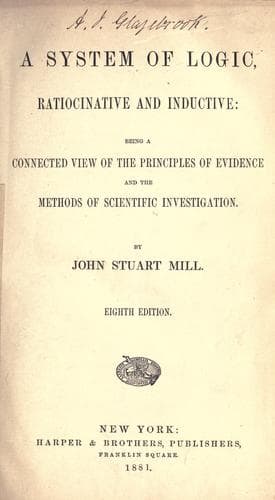
A System of Logic, Ratiocinative and InductiveMill, John Stuart
PhilosophyPhilosophy
A System of Logic, Ratiocinative and Inductive
Mill, John Stuart
Knowledge, Theory of; Logic; Science -- Methodology
their mode of signification, from other connotative names. The classes
which they denote are, as much as any other classes, constituted by
certain common attributes, and their names are significant of those
attributes, and of nothing else. The names of Cuvier’s classes and orders,
_Plantigrades_, _Digitigrades_, etc., are as much the expression of
attributes as if those names had preceded, instead of grown out of, his
classification of animals. The only peculiarity of the case is, that the
convenience of classification was here the primary motive for introducing
the names; while in other cases the name is introduced as a means of
predication, and the formation of a class denoted by it is only an
indirect consequence.
The principles which ought to regulate Classification, as a logical
process subservient to the investigation of truth, can not be discussed to
any purpose until a much later stage of our inquiry. But, of
Classification as resulting from, and implied in, the fact of employing
general language, we can not forbear to treat here, without leaving the
theory of general names, and of their employment in predication, mutilated
and formless.
§ 2. This portion of the theory of general language is the subject of what
is termed the doctrine of the Predicables; a set of distinctions handed
down from Aristotle, and his follower Porphyry, many of which have taken a
firm root in scientific, and some of them even in popular, phraseology.
The predicables are a fivefold division of General Names, not grounded as
usual on a difference in their meaning, that is, in the attribute which
they connote, but on a difference in the kind of class which they denote.
We may predicate of a thing five different varieties of class-name:
A _genus_ of the thing: (γὲνος).
A _species_: (εἶσος).
A _differentia_: (διαφορὰ).
A _proprium_: (ἰδιών).
An _accidens_: (συμβεβηκός).
It is to be remarked of these distinctions, that they express, not what
the predicate is in its own meaning, but what relation it bears to the
subject of which it happens on the particular occasion to be predicated.
There are not some names which are exclusively genera, and others which
are exclusively species, or differentiæ; but the same name is referred to
one or another predicable, according to the subject of which it is
predicated on the particular occasion. _Animal_, for instance, is a genus
with respect to man, or John; a species with respect to Substance, or
Being. _Rectangular_ is one of the Differentiæ of a geometrical square; it
is merely one of the Accidentia of the table at which I am writing. The
words genus, species, etc., are therefore relative terms; they are names
applied to certain predicates, to express the relation between them and
some given subject: a relation grounded, as we shall see, not on what the
predicate connotes, but on the class which it denotes, and on the place
which, in some given classification, that class occupies relatively to the
particular subject.
Public-domain text, read in full here on John Shaqi.
Reviews
Reviews
No reviews yet
Be the first to share your thoughts on this work.
Elsewhere in the archive
Join the Discussion
Join the discussion
Sign in to leave a comment or review.
Sign InorCreate an account