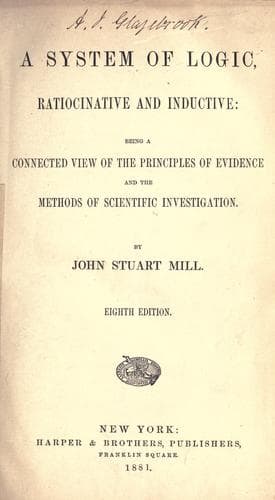
A System of Logic, Ratiocinative and InductiveMill, John Stuart
PhilosophyPhilosophy
A System of Logic, Ratiocinative and Inductive
Mill, John Stuart
Knowledge, Theory of; Logic; Science -- Methodology
§ 4. It is a fundamental principle in logic, that the power of framing
classes is unlimited, as long as there is any (even the smallest)
difference to found a distinction upon. Take any attribute whatever, and
if some things have it, and others have not, we may ground on the
attribute a division of all things into two classes; and we actually do
so, the moment we create a name which connotes the attribute. The number
of possible classes, therefore, is boundless; and there are as many actual
classes (either of real or of imaginary things) as there are general
names, positive and negative together.
But if we contemplate any one of the classes so formed, such as the class
animal or plant, or the class sulphur or phosphorus, or the class white or
red, and consider in what particulars the individuals included in the
class differ from those which do not come within it, we find a very
remarkable diversity in this respect between some classes and others.
There are some classes, the things contained in which differ from other
things only in certain particulars which may be numbered, while others
differ in more than can be numbered, more even than we need ever expect to
know. Some classes have little or nothing in common to characterize them
by, except precisely what is connoted by the name: white things, for
example, are not distinguished by any common properties except whiteness;
or if they are, it is only by such as are in some way dependent on, or
connected with, whiteness. But a hundred generations have not exhausted
the common properties of animals or of plants, of sulphur or of
phosphorus; nor do we suppose them to be exhaustible, but proceed to new
observations and experiments, in the full confidence of discovering new
properties which were by no means implied in those we previously knew.
While, if any one were to propose for investigation the common properties
of all things which are of the same color, the same shape, or the same
specific gravity, the absurdity would be palpable. We have no ground to
believe that any such common properties exist, except such as may be shown
to be involved in the supposition itself, or to be derivable from it by
some law of causation. It appears, therefore, that the properties, on
which we ground our classes, sometimes exhaust all that the class has in
common, or contain it all by some mode of implication; but in other
instances we make a selection of a few properties from among not only a
greater number, but a number inexhaustible by us, and to which as we know
no bounds, they may, so far as we are concerned, be regarded as infinite.
Public-domain text, read in full here on John Shaqi.
Reviews
Reviews
No reviews yet
Be the first to share your thoughts on this work.
Elsewhere in the archive
Join the Discussion
Join the discussion
Sign in to leave a comment or review.
Sign InorCreate an account