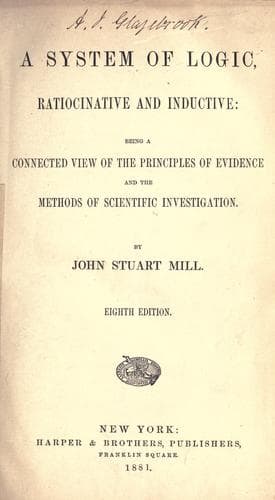
A System of Logic, Ratiocinative and InductiveMill, John Stuart
PhilosophyPhilosophy
A System of Logic, Ratiocinative and Inductive
Mill, John Stuart
Knowledge, Theory of; Logic; Science -- Methodology
There is no impropriety in saying that, of these two classifications, the
one answers to a much more radical distinction in the things themselves,
than the other does. And if any one even chooses to say that the one
classification is made by nature, the other by us for our convenience, he
will be right; provided he means no more than this: Where a certain
apparent difference between things (though perhaps in itself of little
moment) answers to we know not what number of other differences, pervading
not only their known properties, but properties yet undiscovered, it is
not optional but imperative to recognize this difference as the foundation
of a specific distinction; while, on the contrary, differences that are
merely finite and determinate, like those designated by the words white,
black, or red, may be disregarded if the purpose for which the
classification is made does not require attention to those particular
properties. The differences, however, are made by nature, in both cases;
while the recognition of those differences as grounds of classification
and of naming, is, equally in both cases, the act of man: only in the one
case, the ends of language and of classification would be subverted if no
notice were taken of the difference, while in the other case, the
necessity of taking notice of it depends on the importance or unimportance
of the particular qualities in which the difference happens to consist.
Now, these classes, distinguished by unknown multitudes of properties, and
not solely by a few determinate ones—which are parted off from one another
by an unfathomable chasm, instead of a mere ordinary ditch with a visible
bottom—are the only classes which, by the Aristotelian logicians, were
considered as genera or species. Differences which extended only to a
certain property or properties, and there terminated, they considered as
differences only in the _accidents_ of things; but where any class
differed from other things by an infinite series of differences, known and
unknown, they considered the distinction as one of _kind_, and spoke of it
as being an _essential_ difference, which is also one of the current
meanings of that vague expression at the present day.
Public-domain text, read in full here on John Shaqi.
Reviews
Reviews
No reviews yet
Be the first to share your thoughts on this work.
Elsewhere in the archive
Join the Discussion
Join the discussion
Sign in to leave a comment or review.
Sign InorCreate an account