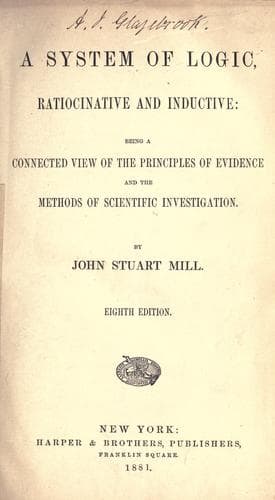
A System of Logic, Ratiocinative and InductiveMill, John Stuart
PhilosophyPhilosophy
A System of Logic, Ratiocinative and Inductive
Mill, John Stuart
Knowledge, Theory of; Logic; Science -- Methodology
(however less in degree) as a horse and a camel do, that is, if their
differences are inexhaustible, and not referrible to any common cause,
they are different species, whether they are descended from common
ancestors or not. But if their differences can all be traced to climate
and habits, or to some one or a few special differences in structure, they
are not, in the logician’s view, specifically distinct.
When the _infima species_, or proximate Kind, to which an individual
belongs, has been ascertained, the properties common to that Kind include
necessarily the whole of the common properties of every other real Kind to
which the individual can be referrible. Let the individual, for example,
be Socrates, and the proximate Kind, man. Animal, or living creature, is
also a real kind, and includes Socrates; but, since it likewise includes
man, or in other words, since all men are animals, the properties common
to animals form a portion of the common properties of the sub-class, man.
And if there be any class which includes Socrates without including man,
that class is not a real Kind. Let the class, for example, be
_flat-nosed_; that being a class which includes Socrates, without
including all men. To determine whether it is a real Kind, we must ask
ourselves this question: Have all flat-nosed animals, in addition to
whatever is implied in their flat noses, any common properties, other than
those which are common to all animals whatever? If they had; if a flat
nose were a mark or index to an indefinite number of other peculiarities,
not deducible from the former by an ascertainable law, then out of the
class man we might cut another class, flat-nosed man, which, according to
our definition, would be a Kind. But if we could do this, man would not
be, as it was assumed to be, the proximate Kind. Therefore, the properties
of the proximate Kind do comprehend those (whether known or unknown) of
all other Kinds to which the individual belongs; which was the point we
undertook to prove. And hence, every other Kind which is predicable of the
individual, will be to the proximate Kind in the relation of a genus,
according to even the popular acceptation of the terms genus and species;
that is, it will be a larger class, including it and more.
Public-domain text, read in full here on John Shaqi.
Reviews
Reviews
No reviews yet
Be the first to share your thoughts on this work.
Elsewhere in the archive
Join the Discussion
Join the discussion
Sign in to leave a comment or review.
Sign InorCreate an account