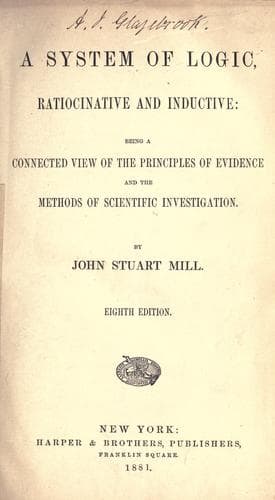
A System of Logic, Ratiocinative and InductiveMill, John Stuart
PhilosophyPhilosophy
A System of Logic, Ratiocinative and Inductive
Mill, John Stuart
Knowledge, Theory of; Logic; Science -- Methodology
We are now able to fix the logical meaning of these terms. Every class
which is a real Kind, that is, which is distinguished from all other
classes by an indeterminate multitude of properties not derivable from one
another, is either a genus or a species. A Kind which is not divisible
into other Kinds, can not be a genus, because it has no species under it;
but it is itself a species, both with reference to the individuals below
and to the genera above (Species Prædicabilis and Species Subjicibilis).
But every Kind which admits of division into real Kinds (as animal into
mammal, bird, fish, etc., or bird into various species of birds) is a
genus to all below it, a species to all genera in which it is itself
included. And here we may close this part of the discussion, and pass to
the three remaining predicables, Differentia, Proprium, and Accidens.
§ 5. To begin with Differentia. This word is correlative with the words
genus and species, and as all admit, it signifies the attribute which
distinguishes a given species from every other species of the same genus.
This is so far clear: but we may still ask, which of the distinguishing
attributes it signifies. For we have seen that every Kind (and a species
must be a Kind) is distinguished from other Kinds, not by any one
attribute, but by an indefinite number. Man, for instance, is a species of
the genus animal: Rational (or rationality, for it is of no consequence
here whether we use the concrete or the abstract form) is generally
assigned by logicians as the Differentia; and doubtless this attribute
serves the purpose of distinction: but it has also been remarked of man,
that he is a cooking animal; the only animal that dresses its food. This,
therefore, is another of the attributes by which the species man is
distinguished from other species of the same genus: would this attribute
serve equally well for a differentia? The Aristotelians say No; having
laid it down that the differentia must, like the genus and species, be of
the _essence_ of the subject.
Public-domain text, read in full here on John Shaqi.
Reviews
Reviews
No reviews yet
Be the first to share your thoughts on this work.
Elsewhere in the archive
Join the Discussion
Join the discussion
Sign in to leave a comment or review.
Sign InorCreate an account