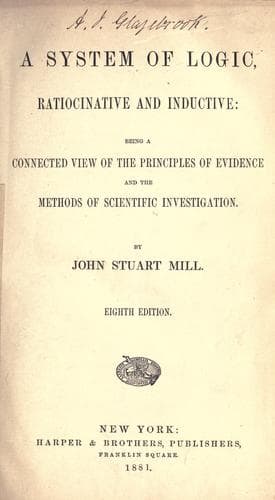
A System of Logic, Ratiocinative and InductiveMill, John Stuart
PhilosophyPhilosophy
A System of Logic, Ratiocinative and Inductive
Mill, John Stuart
Knowledge, Theory of; Logic; Science -- Methodology
And here we lose even that vestige of a meaning grounded in the nature of
the things themselves, which may be supposed to be attached to the word
essence when it is said that genus and species must be of the essence of
the thing. There can be no doubt that when the schoolmen talked of the
essences of things as opposed to their accidents, they had confusedly in
view the distinction between differences of kind, and the differences
which are not of kind; they meant to intimate that genera and species must
be Kinds. Their notion of the essence of a thing was a vague notion of a
something which makes it what it is, _i.e._, which makes it the Kind of
thing that it is—which causes it to have all that variety of properties
which distinguish its Kind. But when the matter came to be looked at more
closely, nobody could discover what caused the thing to have all those
properties, nor even that there was any thing which caused it to have
them. Logicians, however, not liking to admit this, and being unable to
detect what made the thing to be what it was, satisfied themselves with
what made it to be what it was called. Of the innumerable properties,
known and unknown, that are common to the class man, a portion only, and
of course a very small portion, are connoted by its name; these few,
however, will naturally have been thus distinguished from the rest either
for their greater obviousness, or for greater supposed importance. These
properties, then, which were connoted by the name, logicians seized upon,
and called them the essence of the species; and not stopping there, they
affirmed them, in the case of the _infima species_, to be the essence of
the individual too; for it was their maxim, that the species contained the
“whole essence” of the thing. Metaphysics, that fertile field of delusion
propagated by language, does not afford a more signal instance of such
delusion. On this account it was that rationality, being connoted by the
name man, was allowed to be a differentia of the class; but the
peculiarity of cooking their food, not being connoted, was relegated to
the class of accidental properties.
The distinction, therefore, between Differentia, Proprium, and Accidens,
is not grounded in the nature of things, but in the connotation of names;
and we must seek it there, if we wish to find what it is.
Public-domain text, read in full here on John Shaqi.
Reviews
Reviews
No reviews yet
Be the first to share your thoughts on this work.
Elsewhere in the archive
Join the Discussion
Join the discussion
Sign in to leave a comment or review.
Sign InorCreate an account