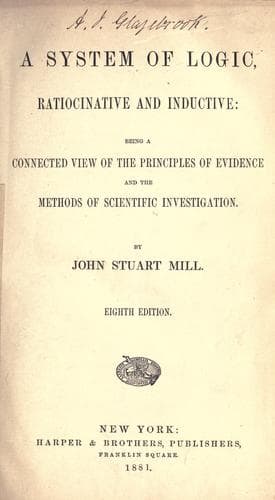
A System of Logic, Ratiocinative and InductiveMill, John Stuart
PhilosophyPhilosophy
A System of Logic, Ratiocinative and Inductive
Mill, John Stuart
Knowledge, Theory of; Logic; Science -- Methodology
If, however, practical convenience is a sufficient warrant for making the
main demarcations in our arrangement of objects run in lines not
coinciding with any distinction of Kind, and so creating genera and
species in the popular sense which are not genera or species in the
rigorous sense at all; _à fortiori_ must we be warranted, when our genera
and species _are_ real genera and species, in marking the distinction
between them by those of their properties which considerations of
practical convenience most strongly recommend. If we cut a species out of
a given genus—the species man, for instance, out of the genus animal—with
an intention on our part that the peculiarity by which we are to be guided
in the application of the name man should be rationality, then rationality
is the differentia of the species man. Suppose, however, that being
naturalists, we, for the purposes of our particular study, cut out of the
genus animal the same species man, but with an intention that the
distinction between man and all other species of animal should be, not
rationality, but the possession of “four incisors in each jaw, tusks
solitary, and erect posture.” It is evident that the word man, when used
by us as naturalists, no longer connotes rationality, but connotes the
three other properties specified; for that which we have expressly in view
when we impose a name, assuredly forms part of the meaning of that name.
We may, therefore, lay it down as a maxim, that wherever there is a Genus,
and a Species marked out from that genus by an assignable differentia, the
name of the species must be connotative, and must connote the differentia;
but the connotation may be special—not involved in the signification of
the term as ordinarily used, but given to it when employed as a term of
art or science. The word Man in common use, connotes rationality and a
certain form, but does not connote the number or character of the teeth;
in the Linnæan system it connotes the number of incisor and canine teeth,
but does not connote rationality nor any particular form. The word _man_
has, therefore, two different meanings; though not commonly considered as
ambiguous, because it happens in both cases to _de_note the same
individual objects. But a case is conceivable in which the ambiguity would
become evident: we have only to imagine that some new kind of animal were
discovered, having Linnæus’s three characteristics of humanity, but not
rational, or not of the human form. In ordinary parlance, these animals
would not be called men; but in natural history they must still be called
so by those, if any there should be, who adhere to the Linnæan
classification; and the question would arise, whether the word should
continue to be used in two senses, or the classification be given up, and
the technical sense of the term be abandoned along with it.
Public-domain text, read in full here on John Shaqi.
Reviews
Reviews
No reviews yet
Be the first to share your thoughts on this work.
Elsewhere in the archive
Join the Discussion
Join the discussion
Sign in to leave a comment or review.
Sign InorCreate an account