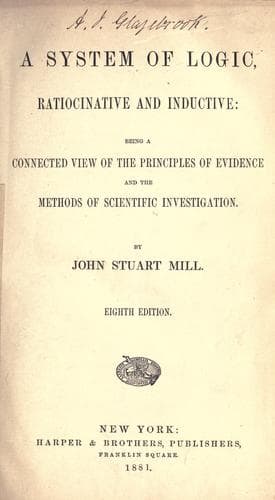
A System of Logic, Ratiocinative and InductiveMill, John Stuart
PhilosophyPhilosophy
A System of Logic, Ratiocinative and Inductive
Mill, John Stuart
Knowledge, Theory of; Logic; Science -- Methodology
Words not otherwise connotative may, in the mode just adverted to, acquire
a special or technical connotation. Thus the word whiteness, as we have so
often remarked, connotes nothing; it merely denotes the attribute
corresponding to a certain sensation: but if we are making a
classification of colors, and desire to justify, or even merely to point
out, the particular place assigned to whiteness in our arrangement, we may
define it “the color produced by the mixture of all the simple rays;” and
this fact, though by no means implied in the meaning of the word whiteness
as ordinarily used, but only known by subsequent scientific investigation,
is part of its meaning in the particular essay or treatise, and becomes
the differentia of the species.(42)
The differentia, therefore, of a species may be defined to be, that part
of the connotation of the specific name, whether ordinary or special and
technical, which distinguishes the species in question from all other
species of the genus to which on the particular occasion we are referring
it.
§ 7. Having disposed of Genus, Species, and Differentia, we shall not find
much difficulty in attaining a clear conception of the distinction between
the other two predicables, as well as between them and the first three.
In the Aristotelian phraseology, Genus and Differentia are of the
_essence_ of the subject; by which, as we have seen, is really meant that
the properties signified by the genus and those signified by the
differentia, form part of the connotation of the name denoting the
species. Proprium and Accidens, on the other hand, form no part of the
essence, but are predicated of the species only _accidentally_. Both are
Accidents, in the wider sense in which the accidents of a thing are
opposed to its essence; though, in the doctrine of the Predicables,
Accidens is used for one sort of accident only, Proprium being another
sort. Proprium, continue the schoolmen, is predicated _accidentally_,
indeed, but _necessarily_; or, as they further explain it, signifies an
attribute which is not indeed part of the essence, but which flows from,
or is a consequence of, the essence, and is, therefore, inseparably
attached to the species; _e.g._, the various properties of a triangle,
which, though no part of its definition, must necessarily be possessed by
whatever comes under that definition. Accidens, on the contrary, has no
connection whatever with the essence, but may come and go, and the species
still remain what it was before. If a species could exist without its
Propria, it must be capable of existing without that on which its Propria
are necessarily consequent, and therefore without its essence, without
that which constitutes it a species. But an Accidens, whether separable or
inseparable from the species in actual experience, may be supposed
separated, without the necessity of supposing any other alteration; or at
least, without supposing any of the essential properties of the species to
Public-domain text, read in full here on John Shaqi.
Reviews
Reviews
No reviews yet
Be the first to share your thoughts on this work.
Elsewhere in the archive
Join the Discussion
Join the discussion
Sign in to leave a comment or review.
Sign InorCreate an account