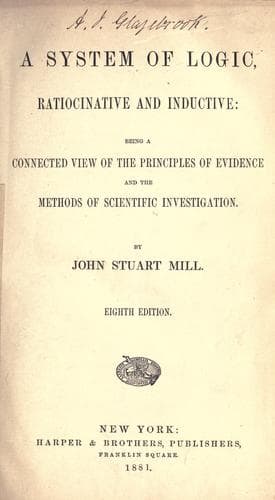
A System of Logic, Ratiocinative and InductiveMill, John Stuart
PhilosophyPhilosophy
A System of Logic, Ratiocinative and Inductive
Mill, John Stuart
Knowledge, Theory of; Logic; Science -- Methodology
This opinion was held by the ancient philosophers, and by their followers,
with the exception of the Nominalists; but as the spirit of modern
metaphysics, until a recent period, has been on the whole a Nominalist
spirit, the notion of definitions of things has been to a certain extent
in abeyance, still continuing, however, to breed confusion in logic, by
its consequences indeed rather than by itself. Yet the doctrine in its own
proper form now and then breaks out, and has appeared (among other places)
where it was scarcely to be expected, in a justly admired word, Archbishop
Whately’s _Logic_.(44) In a review of that work published by me in the
_Westminster __ Review_ for January, 1828, and containing some opinions
which I no longer entertain, I find the following observations on the
question now before us; observations with which my present view of that
question is still sufficiently in accordance.
“The distinction between nominal and real definitions, between definitions
of words and what are called definitions of things, though conformable to
the ideas of most of the Aristotelian logicians, can not, as it appears to
us, be maintained. We apprehend that no definition is ever intended to
‘explain and unfold the nature of a thing.’ It is some confirmation of our
opinion, that none of those writers who have thought that there were
definitions of things, have ever succeeded in discovering any criterion by
which the definition of a thing can be distinguished from any other
proposition relating to the thing. The definition, they say, unfolds the
nature of the thing: but no definition can unfold its whole nature; and
every proposition in which any quality whatever is predicated of the
thing, unfolds some part of its nature. The true state of the case we take
to be this. All definitions are of names, and of names only; but, in some
definitions, it is clearly apparent, that nothing is intended except to
explain the meaning of the word; while in others, besides explaining the
meaning of the word, it is intended to be implied that there exists a
thing, corresponding to the word. Whether this be or be not implied in any
given case, can not be collected from the mere form of the expression. ‘A
centaur is an animal with the upper parts of a man and the lower parts of
a horse,’ and ‘A triangle is a rectilineal figure with three sides,’ are,
in form, expressions precisely similar; although in the former it is not
implied that any _thing_, conformable to the term, really exists, while in
the latter it is; as may be seen by substituting in both definitions, the
word _means_ for _is_. In the first expression, ‘A centaur means an
animal,’ etc., the sense would remain unchanged: in the second, ‘A
triangle means,’ etc., the meaning would be altered, since it would be
obviously impossible to deduce any of the truths of geometry from a
proposition expressive only of the manner in which we intend to employ a
particular sign.
Public-domain text, read in full here on John Shaqi.
Reviews
Reviews
No reviews yet
Be the first to share your thoughts on this work.
Elsewhere in the archive
Join the Discussion
Join the discussion
Sign in to leave a comment or review.
Sign InorCreate an account