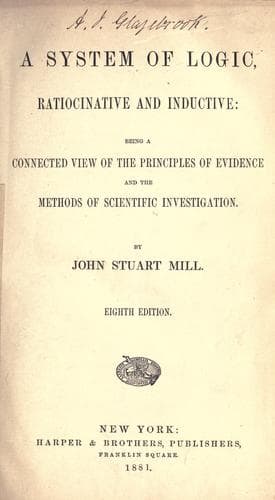
A System of Logic, Ratiocinative and InductiveMill, John Stuart
PhilosophyPhilosophy
A System of Logic, Ratiocinative and Inductive
Mill, John Stuart
Knowledge, Theory of; Logic; Science -- Methodology
“There are, therefore, expressions, commonly passing for definitions,
which include in themselves more than the mere explanation of the meaning
of a term. But it is not correct to call an expression of this sort a
peculiar kind of definition. Its difference from the other kind consists
in this, that it is not a definition, but a definition and something more.
The definition above given of a triangle, obviously comprises not one, but
two propositions, perfectly distinguishable. The one is, ‘There may exist
a figure, bounded by three straight lines;’ the other, ‘And this figure
may be termed a triangle.’ The former of these propositions is not a
definition at all: the latter is a mere nominal definition, or explanation
of the use and application of a term. The first is susceptible of truth or
falsehood, and may therefore be made the foundation of a train of
reasoning. The latter can neither be true nor false; the only character it
is susceptible of is that of conformity or disconformity to the ordinary
usage of language.”
There is a real distinction, then, between definitions of names, and what
are erroneously called definitions of things; but it is, that the latter,
along with the meaning of a name, covertly asserts a matter of fact. This
covert assertion is not a definition, but a postulate. The definition is a
mere identical proposition, which gives information only about the use of
language, and from which no conclusions affecting matters of fact can
possibly be drawn. The accompanying postulate, on the other hand, affirms
a fact, which may lead to consequences of every degree of importance. It
affirms the actual or possible existence of Things possessing the
combination of attributes set forth in the definition; and this, if true,
may be foundation sufficient on which to build a whole fabric of
scientific truth.
We have already made, and shall often have to repeat, the remark, that the
philosophers who overthrew Realism by no means got rid of the consequences
of Realism, but retained long afterward, in their own philosophy, numerous
propositions which could only have a rational meaning as part of a
Realistic system. It had been handed down from Aristotle, and probably
from earlier times, as an obvious truth, that the science of Geometry is
deduced from definitions. This, so long as a definition was considered to
be a proposition “unfolding the nature of the thing,” did well enough. But
Hobbes followed, and rejected utterly the notion that a definition
declares the nature of the thing, or does any thing but state the meaning
of a name; yet he continued to affirm as broadly as any of his
predecessors, that the ἀρχαὶ, _principia_, or original premises of
mathematics, and even of all science, are definitions; producing the
singular paradox, that systems of scientific truth, nay, all truths
whatever at which we arrive by reasoning, are deduced from the arbitrary
conventions of mankind concerning the signification of words.
Public-domain text, read in full here on John Shaqi.
Reviews
Reviews
No reviews yet
Be the first to share your thoughts on this work.
Elsewhere in the archive
Join the Discussion
Join the discussion
Sign in to leave a comment or review.
Sign InorCreate an account