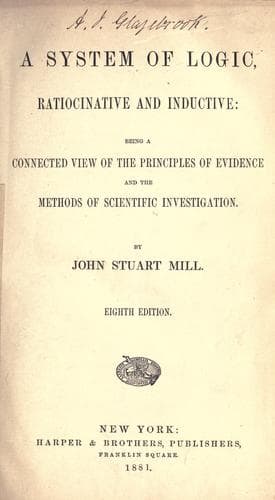
A System of Logic, Ratiocinative and InductiveMill, John Stuart
PhilosophyPhilosophy
A System of Logic, Ratiocinative and Inductive
Mill, John Stuart
Knowledge, Theory of; Logic; Science -- Methodology
Language, as Sir James Mackintosh used to say of governments, “is not
made, but grows.” A name is not imposed at once and by previous purpose
upon a _class_ of objects, but is first applied to one thing, and then
extended by a series of transitions to another and another. By this
process (as has been remarked by several writers, and illustrated with
great force and clearness by Dugald Stewart in his Philosophical Essays) a
name not unfrequently passes by successive links of resemblance from one
object to another, until it becomes applied to things having nothing in
common with the first things to which the name was given; which, however,
do not, for that reason, drop the name; so that it at last denotes a
confused huddle of objects, having nothing whatever in common; and
connotes nothing, not even a vague and general resemblance. When a name
has fallen into this state, in which by predicating it of any object we
assert literally nothing about the object, it has become unfit for the
purposes either of thought or of the communication of thought; and can
only be made serviceable by stripping it of some part of its multifarious
denotation, and confining it to objects possessed of some attributes in
common, which it may be made to connote. Such are the inconveniences of a
language which “is not made, but grows.” Like the governments which are in
a similar case, it may be compared to a road which is not made but has
made itself: it requires continual mending in order to be passable.
From this it is already evident, why the question respecting the
definition of an abstract name is often one of so much difficulty. The
question, What is justice? is, in other words, What is the attribute which
mankind mean to predicate when they call an action just? To which the
first answer is, that having come to no precise agreement on the point,
they do not mean to predicate distinctly any attribute at all.
Nevertheless, all believe that there is some common attribute belonging to
all the actions which they are in the habit of calling just. The question
then must be, whether there is any such common attribute? and, in the
first place, whether mankind agree sufficiently with one another as to the
particular actions which they do or do not call just, to render the
inquiry, what quality those actions have in common, a possible one: if so,
whether the actions really have any quality in common; and if they have,
what it is. Of these three, the first alone is an inquiry into usage and
convention; the other two are inquiries into matters of fact. And if the
second question (whether the actions form a class at all) has been
answered negatively, there remains a fourth, often more arduous than all
the rest, namely, how best to form a class artificially, which the name
may denote.
Public-domain text, read in full here on John Shaqi.
Reviews
Reviews
No reviews yet
Be the first to share your thoughts on this work.
Elsewhere in the archive
Join the Discussion
Join the discussion
Sign in to leave a comment or review.
Sign InorCreate an account