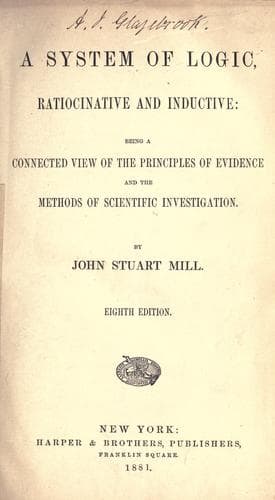
A System of Logic, Ratiocinative and InductiveMill, John Stuart
PhilosophyPhilosophy
A System of Logic, Ratiocinative and Inductive
Mill, John Stuart
Knowledge, Theory of; Logic; Science -- Methodology
But where the resemblances and differences on which our classifications
are founded are not of this palpable and easily determinable kind;
especially where they consist not in any one quality but in a number of
qualities, the effects of which, being blended together, are not very
easily discriminated, and referred each to its true source; it often
happens that names are applied to namable objects, with no distinct
connotation present to the minds of those who apply them. They are only
influenced by a general resemblance between the new object and all or some
of the old familiar objects which they have been accustomed to call by
that name. This, as we have seen, is the law which even the mind of the
philosopher must follow, in giving names to the simple elementary feelings
of our nature: but, where the things to be named are complex wholes, a
philosopher is not content with noticing a general resemblance; he
examines what the resemblance consists in: and he only gives the same name
to things which resemble one another in the same definite particulars. The
philosopher, therefore, habitually employs his general names with a
definite connotation. But language was not made, and can only in some
small degree be mended, by philosophers. In the minds of the real arbiters
of language, general names, especially where the classes they denote can
not be brought before the tribunal of the outward senses to be identified
and discriminated, connote little more than a vague gross resemblance to
the things which they were earliest, or have been most, accustomed to call
by those names. When, for instance, ordinary persons predicate the words
_just_ or _unjust_ of any action, _noble_ or _mean_ of any sentiment,
expression, or demeanor, _statesman_ or _charlatan_ of any personage
figuring in politics, do they mean to affirm of those various subjects any
determinate attributes, of whatever kind? No: they merely recognize, as
they think, some likeness, more or less vague and loose, between these and
some other things which they have been accustomed to denominate or to hear
denominated by those appellations.
Public-domain text, read in full here on John Shaqi.
Reviews
Reviews
No reviews yet
Be the first to share your thoughts on this work.
Elsewhere in the archive
Join the Discussion
Join the discussion
Sign in to leave a comment or review.
Sign InorCreate an account