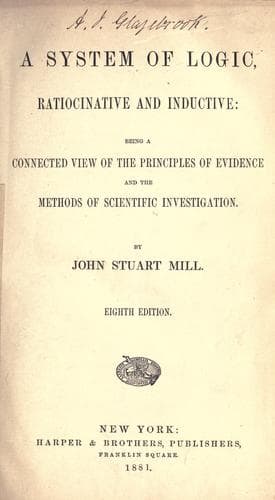
A System of Logic, Ratiocinative and InductiveMill, John Stuart
PhilosophyPhilosophy
A System of Logic, Ratiocinative and Inductive
Mill, John Stuart
Knowledge, Theory of; Logic; Science -- Methodology
Whenever the inquiry into the definition of the name of any real object
consists of any thing else than a mere comparison of authorities, we
tacitly assume that a meaning must be found for the name, compatible with
its continuing to denote, if possible all, but at any rate the greater or
the more important part, of the things of which it is commonly predicated.
The inquiry, therefore, into the definition, is an inquiry into the
resemblances and differences among those things: whether there be any
resemblance running through them all; if not, through what portion of them
such a general resemblance can be traced: and finally, what are the common
attributes, the possession of which gives to them all, or to that portion
of them, the character of resemblance which has led to their being classed
together. When these common attributes have been ascertained and
specified, the name which belongs in common to the resembling objects
acquires a distinct instead of a vague connotation; and by possessing this
distinct connotation, becomes susceptible of definition.
In giving a distinct connotation to the general name, the philosopher will
endeavor to fix upon such attributes as, while they are common to all the
things usually denoted by the name, are also of greatest importance in
themselves; either directly, or from the number, the conspicuousness, or
the interesting character, of the consequences to which they lead. He will
select, as far as possible, such _differentiæ_ as lead to the greatest
number of interesting _propria_. For these, rather than the more obscure
and recondite qualities on which they often depend, give that general
character and aspect to a set of objects, which determine the groups into
which they naturally fall. But to penetrate to the more hidden agreement
on which these obvious and superficial agreements depend, is often one of
the most difficult of scientific problems. As it is among the most
difficult, so it seldom fails to be among the most important. And since
upon the result of this inquiry respecting the causes of the properties of
a class of things, there incidentally depends the question what shall be
the meaning of a word; some of the most profound and most valuable
investigations which philosophy presents to us, have been introduced by,
and have offered themselves under the guise of, inquiries into the
definition of a name.
Book II.
OF REASONING.
Διωρισμένων δε τούτων λέγωμεν ἤδη, διά τίνων, καὶ πότε, καὶ πῶς
γίνεται πᾶς συλλογισμός ὕστερον δὲ λεκτέον περὶ ἀποδείξεως.
Πρότερον γὰρ περὶ συλλογισμοῦ λεκτέον, ἥ περὶ ἀποδείξεως, διὰ τὸ
καθόλου μᾶλλον εἰναὶ τὸν συλλογισμόν. Ἡ μέν γὰρ ἀπόδειξις,
συλλογισμός τις; ὁ συλλογισμός δὲ ού πᾶς, ἀπόδειξις.—ARIST.,
_Analyt. Prior._, l. i., cap. 4.
Chapter I.
Of Inference, Or Reasoning, In General.
Public-domain text, read in full here on John Shaqi.
Reviews
Reviews
No reviews yet
Be the first to share your thoughts on this work.
Elsewhere in the archive
Join the Discussion
Join the discussion
Sign in to leave a comment or review.
Sign InorCreate an account