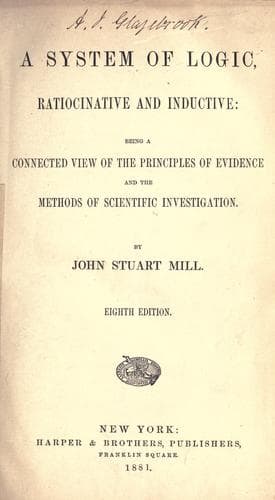
A System of Logic, Ratiocinative and InductiveMill, John Stuart
PhilosophyPhilosophy
A System of Logic, Ratiocinative and Inductive
Mill, John Stuart
Knowledge, Theory of; Logic; Science -- Methodology
§ 1. In the preceding Book, we have been occupied not with the nature of
Proof, but with the nature of Assertion: the import conveyed by a
Proposition, whether that Proposition be true or false; not the means by
which to discriminate true from false Propositions. The proper subject,
however, of Logic is Proof. Before we could understand what Proof is, it
was necessary to understand what that is to which proof is applicable;
what that is which can be a subject of belief or disbelief, of affirmation
or denial; what, in short, the different kinds of Propositions assert.
This preliminary inquiry we have prosecuted to a definite result.
Assertion, in the first place, relates either to the meaning of words, or
to some property of the things which words signify. Assertions respecting
the meaning of words, among which definitions are the most important, hold
a place, and an indispensable one, in philosophy; but as the meaning of
words is essentially arbitrary, this class of assertions are not
susceptible of truth or falsity, nor therefore of proof or disproof.
Assertions respecting Things, or what may be called Real Propositions, in
contradistinction to verbal ones, are of various sorts. We have analyzed
the import of each sort, and have ascertained the nature of the things
they relate to, and the nature of what they severally assert respecting
those things. We found that whatever be the form of the proposition, and
whatever its nominal subject or predicate, the real subject of every
proposition is some one or more facts or phenomena of consciousness, or
some one or more of the hidden causes or powers to which we ascribe those
facts; and that what is predicated or asserted, either in the affirmative
or negative, of those phenomena or those powers, is always either
Existence, Order in Place, Order in Time, Causation, or Resemblance. This,
then, is the theory of the Import of Propositions, reduced to its ultimate
elements: but there is another and a less abstruse expression for it,
which, though stopping short in an earlier stage of the analysis, is
sufficiently scientific for many of the purposes for which such a general
expression is required. This expression recognizes the commonly received
distinction between Subject and Attribute, and gives the following as the
analysis of the meaning of propositions:—Every Proposition asserts, that
some given subject does or does not possess some attribute; or that some
attribute is or is not (either in all or in some portion of the subjects
in which it is met with) conjoined with some other attribute.
We shall now for the present take our leave of this portion of our
inquiry, and proceed to the peculiar problem of the Science of Logic,
namely, how the assertions, of which we have analyzed the import, are
proved or disproved; such of them, at least, as, not being amenable to
direct consciousness or intuition, are appropriate subjects of proof.
Public-domain text, read in full here on John Shaqi.
Reviews
Reviews
No reviews yet
Be the first to share your thoughts on this work.
Elsewhere in the archive
Join the Discussion
Join the discussion
Sign in to leave a comment or review.
Sign InorCreate an account