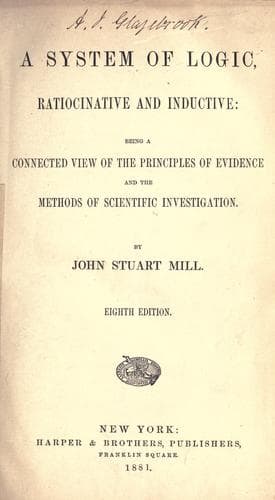
A System of Logic, Ratiocinative and InductiveMill, John Stuart
PhilosophyPhilosophy
A System of Logic, Ratiocinative and Inductive
Mill, John Stuart
Knowledge, Theory of; Logic; Science -- Methodology
We say of a fact or statement, that it is proved, when we believe its
truth by reason of some other fact or statement from which it is said to
_follow_. Most of the propositions, whether affirmative or negative,
universal, particular, or singular, which we believe, are not believed on
their own evidence, but on the ground of something previously assented to,
from which they are said to be _inferred_. To infer a proposition from a
previous proposition or propositions; to give credence to it, or claim
credence for it, as a conclusion from something else; is to _reason_, in
the most extensive sense of the term. There is a narrower sense, in which
the name reasoning is confined to the form of inference which is termed
ratiocination, and of which the syllogism is the general type. The reasons
for not conforming to this restricted use of the term were stated in an
earlier stage of our inquiry, and additional motives will be suggested by
the considerations on which we are now about to enter.
§ 2. In proceeding to take into consideration the cases in which
inferences can legitimately be drawn, we shall first mention some cases in
which the inference is apparent, not real; and which require notice
chiefly that they may not be confounded with cases of inference properly
so called. This occurs when the proposition ostensibly inferred from
another, appears on analysis to be merely a repetition of the same, or
part of the same, assertion, which was contained in the first. All the
cases mentioned in books of Logic as examples of equipollency or
equivalence of propositions, are of this nature. Thus, if we were to
argue, No man is incapable of reason, for every man is rational; or, All
men are mortal, for no man is exempt from death; it would be plain that we
were not proving the proposition, but only appealing to another mode of
wording it, which may or may not be more readily comprehensible by the
hearer, or better adapted to suggest the real proof, but which contains in
itself no shadow of proof.
Another case is where, from a universal proposition, we affect to infer
another which differs from it only in being particular: as All A is B,
therefore Some A is B: No A is B, therefore Some A is not B. This, too, is
not to conclude one proposition from another, but to repeat a second time
something which had been asserted at first; with the difference, that we
do not here repeat the whole of the previous assertion, but only an
indefinite part of it.
Public-domain text, read in full here on John Shaqi.
Reviews
Reviews
No reviews yet
Be the first to share your thoughts on this work.
Elsewhere in the archive
Join the Discussion
Join the discussion
Sign in to leave a comment or review.
Sign InorCreate an account