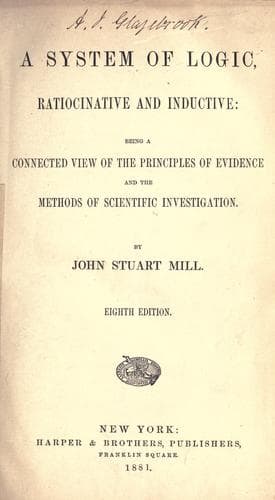
A System of Logic, Ratiocinative and InductiveMill, John Stuart
PhilosophyPhilosophy
A System of Logic, Ratiocinative and Inductive
Mill, John Stuart
Knowledge, Theory of; Logic; Science -- Methodology
In a manual for young students, it would be proper to dwell at greater
length on the conversion and equipollency of propositions. For though that
can not be called reasoning or inference which is a mere re-assertion in
different words of what had been asserted before, there is no more
important intellectual habit, nor any the cultivation of which falls more
strictly within the province of the art of logic, than that of discerning
rapidly and surely the identity of an assertion when disguised under
diversity of language. That important chapter in logical treatises which
relates to the Opposition of Propositions, and the excellent technical
language which logic provides for distinguishing the different kinds or
modes of opposition, are of use chiefly for this purpose. Such
considerations as these, that contrary propositions may both be false, but
can not both be true; that subcontrary propositions may both be true, but
can not both be false; that of two contradictory propositions one must be
true and the other false; that of two subalternate propositions the truth
of the universal proves the truth of the particular, and the falsity of
the particular proves the falsity of the universal, but not _vicè
versa_;(49) are apt to appear, at first sight, very technical and
mysterious, but when explained, seem almost too obvious to require so
formal a statement, since the same amount of explanation which is
necessary to make the principles intelligible, would enable the truths
which they convey to be apprehended in any particular case which can
occur. In this respect, however, these axioms of logic are on a level with
those of mathematics. That things which are equal to the same thing are
equal to one another, is as obvious in any particular case as it is in the
general statement: and if no such general maxim had ever been laid down,
the demonstrations in Euclid would never have halted for any difficulty in
stepping across the gap which this axiom at present serves to bridge over.
Yet no one has ever censured writers on geometry, for placing a list of
these elementary generalizations at the head of their treatises, as a
first exercise to the learner of the faculty which will be required in him
at every step, that of apprehending a _general_ truth. And the student of
logic, in the discussion even of such truths as we have cited above,
acquires habits of circumspect interpretation of words, and of exactly
measuring the length and breadth of his assertions, which are among the
most indispensable conditions of any considerable mental attainment, and
which it is one of the primary objects of logical discipline to cultivate.
Public-domain text, read in full here on John Shaqi.
Reviews
Reviews
No reviews yet
Be the first to share your thoughts on this work.
Elsewhere in the archive
Join the Discussion
Join the discussion
Sign in to leave a comment or review.
Sign InorCreate an account