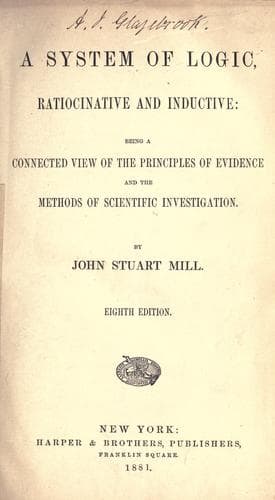
A System of Logic, Ratiocinative and InductiveMill, John Stuart
PhilosophyPhilosophy
A System of Logic, Ratiocinative and Inductive
Mill, John Stuart
Knowledge, Theory of; Logic; Science -- Methodology
§ 3. Having noticed, in order to exclude from the province of Reasoning or
Inference properly so called, the cases in which the progression from one
truth to another is only apparent, the logical consequent being a mere
repetition of the logical antecedent; we now pass to those which are cases
of inference in the proper acceptation of the term, those in which we set
out from known truths, to arrive at others really distinct from them.
Reasoning, in the extended sense in which I use the term, and in which it
is synonymous with Inference, is popularly said to be of two kinds:
reasoning from particulars to generals, and reasoning from generals to
particulars; the former being called Induction, the latter Ratiocination
or Syllogism. It will presently be shown that there is a third species of
reasoning, which falls under neither of these descriptions, and which,
nevertheless, is not only valid, but is the foundation of both the others.
It is necessary to observe, that the expressions, reasoning from
particulars to generals, and reasoning from generals to particulars, are
recommended by brevity rather than by precision, and do not adequately
mark, without the aid of a commentary, the distinction between Induction
(in the sense now adverted to) and Ratiocination. The meaning intended by
these expressions is, that Induction is inferring a proposition from
propositions _less general_ than itself, and Ratiocination is inferring a
proposition from propositions _equally_ or _more_ general. When, from the
observation of a number of individual instances, we ascend to a general
proposition, or when, by combining a number of general propositions, we
conclude from them another proposition still more general, the process,
which is substantially the same in both instances, is called Induction.
When from a general proposition, not alone (for from a single proposition
nothing can be concluded which is not involved in the terms), but by
combining it with other propositions, we infer a proposition of the same
degree of generality with itself, or a less general proposition, or a
proposition merely individual, the process is Ratiocination. When, in
short, the conclusion is more general than the largest of the premises,
the argument is commonly called Induction; when less general, or equally
general, it is Ratiocination.
Public-domain text, read in full here on John Shaqi.
Reviews
Reviews
No reviews yet
Be the first to share your thoughts on this work.
Elsewhere in the archive
Join the Discussion
Join the discussion
Sign in to leave a comment or review.
Sign InorCreate an account