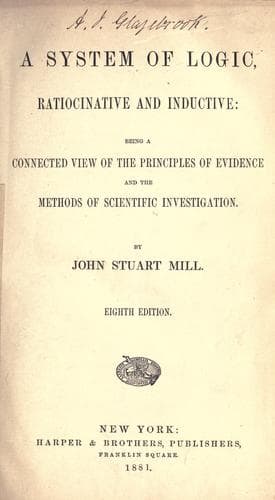
A System of Logic, Ratiocinative and InductiveMill, John Stuart
PhilosophyPhilosophy
A System of Logic, Ratiocinative and Inductive
Mill, John Stuart
Knowledge, Theory of; Logic; Science -- Methodology
As all experience begins with individual cases, and proceeds from them to
generals, it might seem most conformable to the natural order of thought
that Induction should be treated of before we touch upon Ratiocination. It
will, however, be advantageous, in a science which aims at tracing our
acquired knowledge to its sources, that the inquirer should commence with
the latter rather than with the earlier stages of the process of
constructing our knowledge; and should trace derivative truths backward to
the truths from which they are deduced, and on which they depend for their
evidence, before attempting to point out the original spring from which
both ultimately take their rise. The advantages of this order of
proceeding in the present instance will manifest themselves as we advance,
in a manner superseding the necessity of any further justification or
explanation.
Of Induction, therefore, we shall say no more at present, than that it at
least is, without doubt, a process of real inference. The conclusion in an
induction embraces more than is contained in the premises. The principle
or law collected from particular instances, the general proposition in
which we embody the result of our experience, covers a much larger extent
of ground than the individual experiments which form its basis. A
principle ascertained by experience, is more than a mere summing up of
what has been specifically observed in the individual cases which have
been examined; it is a generalization grounded on those cases, and
expressive of our belief, that what we there found true is true in an
indefinite number of cases which we have not examined, and are never
likely to examine. The nature and grounds of this inference, and the
conditions necessary to make it legitimate, will be the subject of
discussion in the Third Book: but that such inference really takes place
is not susceptible of question. In every induction we proceed from truths
which we knew, to truths which we did not know; from facts certified by
observation, to facts which we have not observed, and even to facts not
capable of being now observed; future facts, for example; but which we do
not hesitate to believe on the sole evidence of the induction itself.
Induction, then, is a real process of Reasoning or Inference. Whether, and
in what sense, as much can be said of the Syllogism, remains to be
determined by the examination into which we are about to enter.
Chapter II.
Of Ratiocination, Or Syllogism.
§ 1. The analysis of the Syllogism has been so accurately and fully
performed in the common manuals of Logic, that in the present work, which
is not designed as a manual, it is sufficient to recapitulate, _memoriæ
causâ_, the leading results of that analysis, as a foundation for the
remarks to be afterward made on the functions of the Syllogism, and the
place which it holds in science.
Public-domain text, read in full here on John Shaqi.
Reviews
Reviews
No reviews yet
Be the first to share your thoughts on this work.
Elsewhere in the archive
Join the Discussion
Join the discussion
Sign in to leave a comment or review.
Sign InorCreate an account