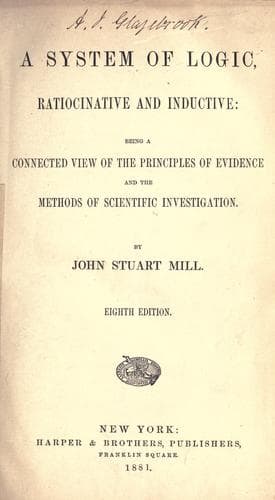
A System of Logic, Ratiocinative and InductiveMill, John Stuart
PhilosophyPhilosophy
A System of Logic, Ratiocinative and Inductive
Mill, John Stuart
Knowledge, Theory of; Logic; Science -- Methodology
All B is No B is C Some B is All B is Some B is No B is C
C C C not C
All B is All B is All B is Some B is All B is Some B is
A A A A A A
therefore therefore therefore therefore therefore therefore
Some A is Some A is Some A is Some A is Some A is Some A is
C not C C C not C not C
FOURTH FIGURE.
All C is B All C is B Some C is B No C is B No C is B
All B is A No B is A All B is A All B is A Some B is A
therefore therefore therefore therefore therefore
Some A is C Some A is Some A is C Some A is Some A is
not C not C not C
In these exemplars, or blank forms for making syllogisms, no place is
assigned to _singular_ propositions; not, of course, because such
propositions are not used in ratiocination, but because, their predicate
being affirmed or denied of the whole of the subject, they are ranked, for
the purposes of the syllogism, with universal propositions. Thus, these
two syllogisms—
All men are mortal, All men are mortal,
All kings are men, Socrates is a man,
therefore therefore
All kings are mortal, Socrates is mortal,
are arguments precisely similar, and are both ranked in the first mood of
the first figure.(50)
The reasons why syllogisms in any of the above forms are legitimate, that
is, why, if the premises are true, the conclusion must inevitably be so,
and why this is not the case in any other possible mood (that is, in any
other combination of universal and particular, affirmative and negative
propositions), any person taking interest in these inquiries may be
presumed to have either learned from the common-school books of the
syllogistic logic, or to be capable of discovering for himself. The reader
may, however, be referred, for every needful explanation, to Archbishop
Whately’s _Elements of Logic_, where he will find stated with
philosophical precision, and explained with remarkable perspicuity, the
whole of the common doctrine of the syllogism.
All valid ratiocination; all reasoning by which, from general propositions
previously admitted, other propositions equally or less general are
inferred; may be exhibited in some of the above forms. The whole of
Euclid, for example, might be thrown without difficulty into a series of
syllogisms, regular in mood and figure.
Though a syllogism framed according to any of these formulæ is a valid
argument, all correct ratiocination admits of being stated in syllogisms
of the first figure alone. The rules for throwing an argument in any of
the other figures into the first figure, are called rules for the
_reduction_ of syllogisms. It is done by the _conversion_ of one or other,
or both, of the premises. Thus an argument in the first mood of the second
figure, as—
Public-domain text, read in full here on John Shaqi.
Reviews
Reviews
No reviews yet
Be the first to share your thoughts on this work.
Elsewhere in the archive
Join the Discussion
Join the discussion
Sign in to leave a comment or review.
Sign InorCreate an account