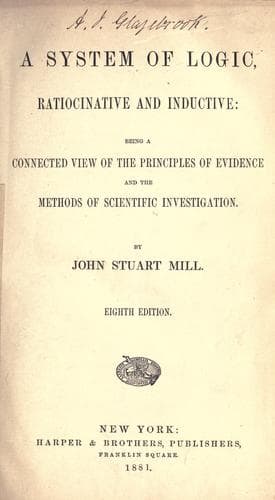
A System of Logic, Ratiocinative and InductiveMill, John Stuart
PhilosophyPhilosophy
A System of Logic, Ratiocinative and Inductive
Mill, John Stuart
Knowledge, Theory of; Logic; Science -- Methodology
No C is B
All A is B
therefore
No A is C,
may be reduced as follows. The proposition, No C is B, being a universal
negative, admits of simple conversion, and may be changed into No B is C,
which, as we showed, is the very same assertion in other words—the same
fact differently expressed. This transformation having been effected, the
argument assumes the following form:
No B is C
All A is B
therefore
No A is C,
which is a good syllogism in the second mood of the first figure. Again,
an argument in the first mood of the third figure must resemble the
following:
All B is C
All B is A
therefore
Some A is C,
where the minor premise, All B is A, conformably to what was laid down in
the last chapter respecting universal affirmatives, does not admit of
simple conversion, but may be converted _per accidens_, thus, Some A is B;
which, though it does not express the whole of what is asserted in the
proposition All B is A, expresses, as was formerly shown, part of it, and
must therefore be true if the whole is true. We have, then, as the result
of the reduction, the following syllogism in the third mood of the first
figure:
All B is C
Some A is B,
from which it obviously follows, that
Some A is C.
In the same manner, or in a manner on which after these examples it is not
necessary to enlarge, every mood of the second, third, and fourth figures
may be reduced to some one of the four moods of the first. In other words,
every conclusion which can be proved in any of the last three figures, may
be proved in the first figure from the same premises, with a slight
alteration in the mere manner of expressing them. Every valid
ratiocination, therefore, may be stated in the first figure, that is, in
one of the following forms:
Every B is C No B is C
All A is B, All A is B,
Some A is B, Some A is B,
therefore therefore
All A is C. No A is C.
Some A is C. Some A is not C.
Or, if more significant symbols are preferred:
To prove an affirmative, the argument must admit of being stated in this
form:
All animals are mortal;
All men/Some men/Socrates are animals;
therefore
All men/Some men/Socrates are mortal.
To prove a negative, the argument must be capable of being expressed in
this form:
No one who is capable of self-control is necessarily vicious;
All negroes/Some negroes/Mr. A’s negro are capable of self-control;
therefore
No negroes are/Some negroes are not/Mr. A’s negro is not necessarily
vicious.
Public-domain text, read in full here on John Shaqi.
Reviews
Reviews
No reviews yet
Be the first to share your thoughts on this work.
Elsewhere in the archive
Join the Discussion
Join the discussion
Sign in to leave a comment or review.
Sign InorCreate an account