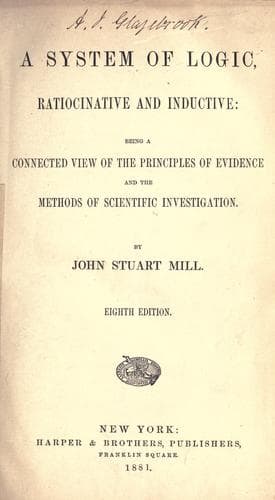
A System of Logic, Ratiocinative and InductiveMill, John Stuart
PhilosophyPhilosophy
A System of Logic, Ratiocinative and Inductive
Mill, John Stuart
Knowledge, Theory of; Logic; Science -- Methodology
affirmed of every object contained in the class? The class _is_ nothing
but the objects contained in it: and the _dictum de omni_ merely amounts
to the identical proposition, that whatever is true of certain objects, is
true of each of those objects. If all ratiocination were no more than the
application of this maxim to particular cases, the syllogism would indeed
be, what it has so often been declared to be, solemn trifling. The _dictum
de omni_ is on a par with another truth, which in its time was also
reckoned of great importance, “Whatever is, is.” To give any real meaning
to the _dictum de omni_, we must consider it not as an axiom, but as a
definition; we must look upon it as intended to explain, in a circuitous
and paraphrastic manner, the meaning of the word _class_.
An error which seemed finally refuted and dislodged from thought, often
needs only put on a new suit of phrases, to be welcomed back to its old
quarters, and allowed to repose unquestioned for another cycle of ages.
Modern philosophers have not been sparing in their contempt for the
scholastic dogma that genera and species are a peculiar kind of
substances, which general substances being the only permanent things,
while the individual substances comprehended under them are in a perpetual
flux, knowledge, which necessarily imports stability, can only have
relation to those general substances or universals, and not to the facts
or particulars included under them. Yet, though nominally rejected, this
very doctrine, whether disguised under the Abstract Ideas of Locke (whose
speculations, however, it has less vitiated than those of perhaps any
other writer who has been infected with it), under the ultra-nominalism of
Hobbes and Condillac, or the ontology of the later German schools, has
never ceased to poison philosophy. Once accustomed to consider scientific
investigation as essentially consisting in the study of universals, men
did not drop this habit of thought when they ceased to regard universals
as possessing an independent existence: and even those who went the length
of considering them as mere names, could not free themselves from the
notion that the investigation of truth consisted entirely or partly in
some kind of conjuration or juggle with those names. When a philosopher
adopted fully the Nominalist view of the signification of general
language, retaining along with it the _dictum de omni_ as the foundation
of all reasoning, two such premises fairly put together were likely, if he
was a consistent thinker, to land him in rather startling conclusions.
Accordingly it has been seriously held, by writers of deserved celebrity,
that the process of arriving at new truths by reasoning consists in the
mere substitution of one set of arbitrary signs for another; a doctrine
which they suppose to derive irresistible confirmation from the example of
algebra. If there were any process in sorcery or necromancy more
preternatural than this, I should be much surprised.
Public-domain text, read in full here on John Shaqi.
Reviews
Reviews
No reviews yet
Be the first to share your thoughts on this work.
Elsewhere in the archive
Join the Discussion
Join the discussion
Sign in to leave a comment or review.
Sign InorCreate an account