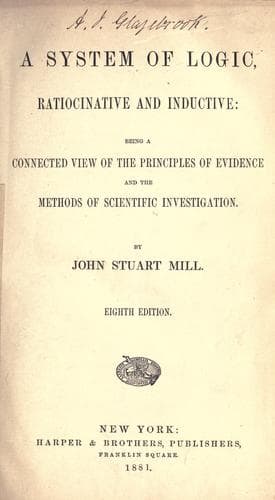
A System of Logic, Ratiocinative and InductiveMill, John Stuart
PhilosophyPhilosophy
A System of Logic, Ratiocinative and Inductive
Mill, John Stuart
Knowledge, Theory of; Logic; Science -- Methodology
The other premise is always affirmative, and asserts that something (which
may be either an individual, a class, or part of a class) belongs to, or
is included in, the class respecting which something was affirmed or
denied in the major premise. It follows that the attribute affirmed or
denied of the entire class may (if that affirmation or denial was correct)
be affirmed or denied of the object or objects alleged to be included in
the class: and this is precisely the assertion made in the conclusion.
Whether or not the foregoing is an adequate account of the constituent
parts of the syllogism, will be presently considered; but as far as it
goes it is a true account. It has accordingly been generalized, and
erected into a logical maxim, on which all ratiocination is said to be
founded, insomuch that to reason, and to apply the maxim, are supposed to
be one and the same thing. The maxim is, That whatever can be affirmed (or
denied) of a class, may be affirmed (or denied) of every thing included in
the class. This axiom, supposed to be the basis of the syllogistic theory,
is termed by logicians the _dictum de omni et nullo_.
This maxim, however, when considered as a principle of reasoning, appears
suited to a system of metaphysics once indeed generally received, but
which for the last two centuries has been considered as finally abandoned,
though there have not been wanting in our own day attempts at its revival.
So long as what are termed Universals were regarded as a peculiar kind of
substances, having an objective existence distinct from the individual
objects classed under them, the _dictum de omni_ conveyed an important
meaning; because it expressed the intercommunity of nature, which it was
necessary on that theory that we should suppose to exist between those
general substances and the particular substances which were subordinated
to them. That every thing predicable of the universal was predicable of
the various individuals contained under it, was then no identical
proposition, but a statement of what was conceived as a fundamental law of
the universe. The assertion that the entire nature and properties of the
_substantia secunda_ formed part of the nature and properties of each of
the individual substances called by the same name; that the properties of
Man, for example, were properties of all men; was a proposition of real
significance when man did not _mean_ all men, but something inherent in
men, and vastly superior to them in dignity. Now, however, when it is
known that a class, a universal, a genus or species, is not an entity _per
se_, but neither more nor less than the individual substances themselves
which are placed in the class, and that there is nothing real in the
matter except those objects, a common name given to them, and common
attributes indicated by the name; what, I should be glad to know, do we
learn by being told, that whatever can be affirmed of a class, may be
Public-domain text, read in full here on John Shaqi.
Reviews
Reviews
No reviews yet
Be the first to share your thoughts on this work.
Elsewhere in the archive
Join the Discussion
Join the discussion
Sign in to leave a comment or review.
Sign InorCreate an account