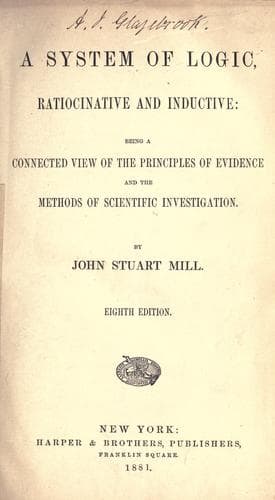
A System of Logic, Ratiocinative and InductiveMill, John Stuart
PhilosophyPhilosophy
A System of Logic, Ratiocinative and Inductive
Mill, John Stuart
Knowledge, Theory of; Logic; Science -- Methodology
§ 3. Those who considered the _dictum de omni_ as the foundation of the
syllogism, looked upon arguments in a manner corresponding to the
erroneous view which Hobbes took of propositions. Because there are some
propositions which are merely verbal, Hobbes, in order apparently that his
definition might be rigorously universal, defined a proposition as if no
propositions declared any thing except the meaning of words. If Hobbes was
right; if no further account than this could be given of the import of
propositions; no theory could be given but the commonly received one, of
the combination of propositions in a syllogism. If the minor premise
asserted nothing more than that something belongs to a class, and if the
major premise asserted nothing of that class except that it is included in
another class, the conclusion would only be that what was included in the
lower class is included in the higher, and the result, therefore, nothing
except that the classification is consistent with itself. But we have seen
that it is no sufficient account of the meaning of a proposition, to say
that it refers something to, or excludes something from, a class. Every
proposition which conveys real information asserts a matter of fact,
dependent on the laws of nature, and not on classification. It asserts
that a given object does or does not possess a given attribute; or it
asserts that two attributes, or sets of attributes, do or do not
(constantly or occasionally) co-exist. Since such is the purport of all
propositions which convey any real knowledge, and since ratiocination is a
mode of acquiring real knowledge, any theory of ratiocination which does
not recognize this import of propositions, can not, we may be sure, be the
true one.
Applying this view of propositions to the two premises of a syllogism, we
obtain the following results. The major premise, which, as already
remarked, is always universal, asserts, that all things which have a
certain attribute (or attributes) have or have not along with it, a
certain other attribute (or attributes). The minor premise asserts that
the thing or set of things which are the subject of that premise, have the
first-mentioned attribute; and the conclusion is, that they have (or that
they have not), the second. Thus in our former example,
All men are mortal,
Socrates is a man,
therefore
Socrates is mortal,
the subject and predicate of the major premise are connotative terms,
denoting objects and connoting attributes. The assertion in the major
premise is, that along with one of the two sets of attributes, we always
find the other: that the attributes connoted by “man” never exist unless
conjoined with the attribute called mortality. The assertion in the minor
premise is that the individual named Socrates possesses the former
attributes; and it is concluded that he possesses also the attribute
mortality. Or, if both the premises are general propositions, as
Public-domain text, read in full here on John Shaqi.
Reviews
Reviews
No reviews yet
Be the first to share your thoughts on this work.
Elsewhere in the archive
Join the Discussion
Join the discussion
Sign in to leave a comment or review.
Sign InorCreate an account