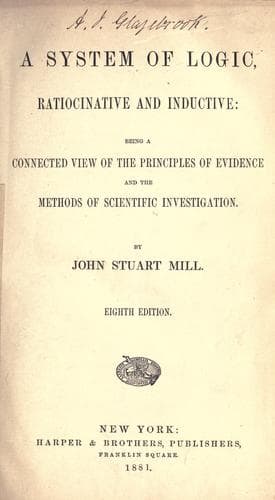
A System of Logic, Ratiocinative and InductiveMill, John Stuart
PhilosophyPhilosophy
A System of Logic, Ratiocinative and Inductive
Mill, John Stuart
Knowledge, Theory of; Logic; Science -- Methodology
All men are mortal,
All kings are men,
therefore
All kings are mortal,
the minor premise asserts that the attributes denoted by kingship only
exist in conjunction with those signified by the word man. The major
asserts as before, that the last-mentioned attributes are never found
without the attribute of mortality. The conclusion is, that wherever the
attributes of kingship are found, that of mortality is found also.
If the major premise were negative, as, No men are omnipotent, it would
assert, not that the attributes connoted by “man” never exist without, but
that they never exist with, those connoted by “omnipotent:” from which,
together with the minor premise, it is concluded, that the same
incompatibility exists between the attribute omnipotence and those
constituting a king. In a similar manner we might analyze any other
example of the syllogism.
If we generalize this process, and look out for the principle or law
involved in every such inference, and presupposed in every syllogism, the
propositions of which are any thing more than merely verbal; we find, not
the unmeaning _dictum de omni et nullo_, but a fundamental principle, or
rather two principles, strikingly resembling the axioms of mathematics.
The first, which is the principle of affirmative syllogisms, is, that
things which co-exist with the same thing, co-exist with one another: or
(still more precisely) a thing which co-exists with another thing, which
other co-exists with a third thing, also co-exists with that third thing.
The second is the principle of negative syllogisms, and is to this effect:
that a thing which co-exists with another thing, with which other a third
thing does not co-exist, is not co-existent with that third thing. These
axioms manifestly relate to facts, and not to conventions; and one or
other of them is the ground of the legitimacy of every argument in which
facts and not conventions are the matter treated of.(53)
§ 4. It remains to translate this exposition of the syllogism from the one
into the other of the two languages in which we formerly remarked(54) that
all propositions, and of course therefore all combinations of
propositions, might be expressed. We observed that a proposition might be
considered in two different lights; as a portion of our knowledge of
nature, or as a memorandum for our guidance. Under the former, or
speculative aspect, an affirmative general proposition is an assertion of
a speculative truth, viz., that whatever has a certain attribute has a
certain other attribute. Under the other aspect, it is to be regarded not
as a part of our knowledge, but as an aid for our practical exigencies, by
enabling us, when we see or learn that an object possesses one of the two
attributes, to infer that it possesses the other; thus employing the first
attribute as a mark or evidence of the second. Thus regarded, every
syllogism comes within the following general formula:
Public-domain text, read in full here on John Shaqi.
Reviews
Reviews
No reviews yet
Be the first to share your thoughts on this work.
Elsewhere in the archive
Join the Discussion
Join the discussion
Sign in to leave a comment or review.
Sign InorCreate an account