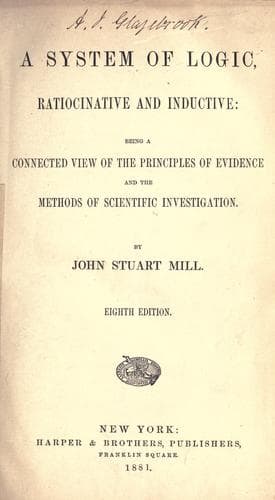
A System of Logic, Ratiocinative and InductiveMill, John Stuart
PhilosophyPhilosophy
A System of Logic, Ratiocinative and Inductive
Mill, John Stuart
Knowledge, Theory of; Logic; Science -- Methodology
And since a large portion of our knowledge is thus acquired, logicians
have persisted in representing the syllogism as a process of inference or
proof; though none of them has cleared up the difficulty which arises from
the inconsistency between that assertion, and the principle, that if there
be any thing in the conclusion which was not already asserted in the
premises, the argument is vicious. For it is impossible to attach any
serious scientific value to such a mere salvo, as the distinction drawn
between being involved _by implication_ in the premises, and being
directly asserted in them. When Archbishop Whately says(56) that the
object of reasoning is “merely to expand and unfold the assertions wrapped
up, as it were, and implied in those with which we set out, and to bring a
person to perceive and acknowledge the full force of that which he has
admitted,” he does not, I think, meet the real difficulty requiring to be
explained, namely, how it happens that a science, like geometry, _can_ be
all “wrapped up” in a few definitions and axioms. Nor does this defense of
the syllogism differ much from what its assailants urge against it as an
accusation, when they charge it with being of no use except to those who
seek to press the consequences of an admission into which a person has
been entrapped without having considered and understood its full force.
When you admitted the major premise, you asserted the conclusion; but,
says Archbishop Whately, you asserted it by implication merely: this,
however, can here only mean that you asserted it unconsciously; that you
did not know you were asserting it; but, if so, the difficulty revives in
this shape—Ought you not to have known? Were you warranted in asserting
the general proposition without having satisfied yourself of the truth of
every thing which it fairly includes? And if not, is not the syllogistic
art _prima facie_ what its assailants affirm it to be, a contrivance for
catching you in a trap, and holding you fast in it?(57)
§ 3. From this difficulty there appears to be but one issue. The
proposition that the Duke of Wellington is mortal, is evidently an
inference; it is got at as a conclusion from something else; but do we, in
reality, conclude it from the proposition, All men are mortal? I answer,
no.
The error committed is, I conceive, that of overlooking the distinction
between two parts of the process of philosophizing, the inferring part,
and the registering part; and ascribing to the latter the functions of the
former. The mistake is that of referring a person to his own notes for the
origin of his knowledge. If a person is asked a question, and is at the
moment unable to answer it, he may refresh his memory by turning to a
memorandum which he carries about with him. But if he were asked, how the
fact came to his knowledge, he would scarcely answer, because it was set
down in his note-book: unless the book was written, like the Koran, with a
quill from the wing of the angel Gabriel.
Public-domain text, read in full here on John Shaqi.
Reviews
Reviews
No reviews yet
Be the first to share your thoughts on this work.
Elsewhere in the archive
Join the Discussion
Join the discussion
Sign in to leave a comment or review.
Sign InorCreate an account