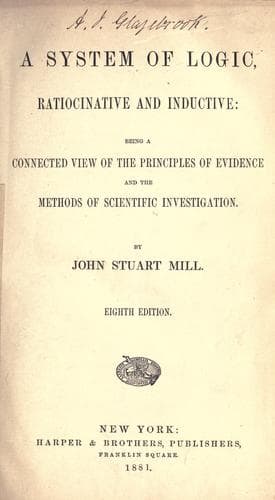
A System of Logic, Ratiocinative and InductiveMill, John Stuart
PhilosophyPhilosophy
A System of Logic, Ratiocinative and Inductive
Mill, John Stuart
Knowledge, Theory of; Logic; Science -- Methodology
it is unanswerably urged by the adversaries of the syllogistic theory,
that the proposition, Socrates is mortal, is presupposed in the more
general assumption, All men are mortal: that we can not be assured of the
mortality of all men, unless we are already certain of the mortality of
every individual man: that if it be still doubtful whether Socrates, or
any other individual we choose to name, be mortal or not, the same degree
of uncertainty must hang over the assertion, All men are mortal: that the
general principle, instead of being given as evidence of the particular
case, can not itself be taken for true without exception, until every
shadow of doubt which could affect any case comprised with it, is
dispelled by evidence _aliundè_; and then what remains for the syllogism
to prove? That, in short, no reasoning from generals to particulars can,
as such, prove any thing: since from a general principle we can not infer
any particulars, but those which the principle itself assumes as known.
This doctrine appears to me irrefragable; and if logicians, though unable
to dispute it, have usually exhibited a strong disposition to explain it
away, this was not because they could discover any flaw in the argument
itself, but because the contrary opinion seemed to rest on arguments
equally indisputable. In the syllogism last referred to, for example, or
in any of those which we previously constructed, is it not evident that
the conclusion may, to the person to whom the syllogism is presented, be
actually and _bona fide_ a new truth? Is it not matter of daily experience
that truths previously unthought of, facts which have not been, and can
not be, directly observed, are arrived at by way of general reasoning? We
believe that the Duke of Wellington is mortal. We do not know this by
direct observation, so long as he is not yet dead. If we were asked how,
this being the case, we know the duke to be mortal, we should probably
answer, Because all men are so. Here, therefore, we arrive at the
knowledge of a truth not (as yet) susceptible of observation, by a
reasoning which admits of being exhibited in the following syllogism:
All men are mortal,
The Duke of Wellington is a man,
therefore
The Duke of Wellington is mortal.
Public-domain text, read in full here on John Shaqi.
Reviews
Reviews
No reviews yet
Be the first to share your thoughts on this work.
Elsewhere in the archive
Join the Discussion
Join the discussion
Sign in to leave a comment or review.
Sign InorCreate an account