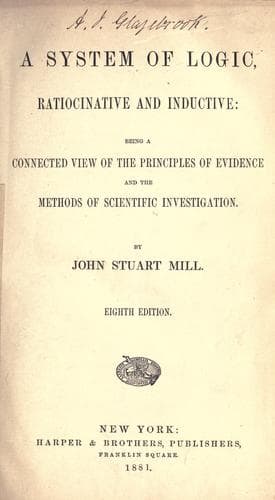
A System of Logic, Ratiocinative and InductiveMill, John Stuart
PhilosophyPhilosophy
A System of Logic, Ratiocinative and Inductive
Mill, John Stuart
Knowledge, Theory of; Logic; Science -- Methodology
In this last phrase we have obtained an expression which appears to me to
characterize, more aptly than any other, the functions of the syllogism in
all cases. When the premises are given by authority, the function of
Reasoning is to ascertain the testimony of a witness, or the will of a
legislator, by interpreting the signs in which the one has intimated his
assertion and the other his command. In like manner, when the premises are
derived from observation, the function of Reasoning is to ascertain what
we (or our predecessors) formerly thought might be inferred from the
observed facts, and to do this by interpreting a memorandum of ours, or of
theirs. The memorandum reminds us, that from evidence, more or less
carefully weighed, it formerly appeared that a certain attribute might be
inferred wherever we perceive a certain mark. The proposition, All men are
mortal (for instance) shows that we have had experience from which we
thought it followed that the attributes connoted by the term man, are a
mark of mortality. But when we conclude that the Duke of Wellington is
mortal, we do not infer this from the memorandum, but from the former
experience. All that we infer from the memorandum is our own previous
belief, (or that of those who transmitted to us the proposition),
concerning the inferences which that former experience would warrant.
This view of the nature of the syllogism renders consistent and
intelligible what otherwise remains obscure and confused in the theory of
Archbishop Whately and other enlightened defenders of the syllogistic
doctrine, respecting the limits to which its functions are confined. They
affirm in as explicit terms as can be used, that the sole office of
general reasoning is to prevent inconsistency in our opinions; to prevent
us from assenting to any thing, the truth of which would contradict
something to which we had previously on good grounds given our assent. And
they tell us, that the sole ground which a syllogism affords for assenting
to the conclusion, is that the supposition of its being false, combined
with the supposition that the premises are true, would lead to a
contradiction in terms. Now this would be but a lame account of the real
grounds which we have for believing the facts which we learn from
reasoning, in contradistinction to observation. The true reason why we
believe that the Duke of Wellington will die, is that his fathers, and our
fathers, and all other persons who were contemporary with them, have died.
Those facts are the real premises of the reasoning. But we are not led to
infer the conclusion from those premises, by the necessity of avoiding any
verbal inconsistency. There is no contradiction in supposing that all
those persons have died, and that the Duke of Wellington may,
notwithstanding, live forever. But there would be a contradiction if we
first, on the ground of those same premises, made a general assertion
including and covering the case of the Duke of Wellington, and then
Public-domain text, read in full here on John Shaqi.
Reviews
Reviews
No reviews yet
Be the first to share your thoughts on this work.
Elsewhere in the archive
Join the Discussion
Join the discussion
Sign in to leave a comment or review.
Sign InorCreate an account